You need to leave Toronto for these unique farm-to-table experiences
Seven delicious reasons to take a road trip this summer
The first wave of farm-to-table dining—championed in Toronto by chefs Michael Stadtländer and Jamie Kennedy—was about bringing the farm to the city. Restaurants traded imported prestige for southern Ontario–grown goodness, proving that local could be a luxury.
Related: Ten Michelin-approved restaurants a short road trip from Toronto
Forty years later, the tables have turned: rather than haul the harvest into Toronto, a new generation of restaurateurs is enticing city folk out to the fields, where dinner is cooked just steps from where it’s grown or raised. Call it farm-to-table 2.0. Here, seven worth-the-drive experiences, all within three hours of Toronto, where you can taste the terroir.
Littlejohn Farm
908 County Rd. 10, Picton, 647-716-7737, littlejohnfarm.com
Drive time: 2.5 hours Cost: $141 and up

Farming runs deep in the Littlejohn family. Zach Littlejohn’s great-great-grandfather farmed commercially in southwestern Ontario, but Littlejohn’s own introduction to farming came on a 25-acre Stouffville hobby farm, where his veterinarian father raised animals and their family ate off the land. It was there that he fell for a more intimate version of farming. “The romance of farming is in the scale of it,” says Littlejohn.

Nine years ago, Littlejohn and his wife, Luhana, set out to capture that romance in Prince Edward County, transforming three and a half acres into a European-inspired agritourism destination. Dinner starts with a stroll past grazing sheep and garden beds bursting with ingredients destined for the plate, before guests settle beneath grapevine-covered trellises (or inside a glass-enclosed, greenhouse-like dining room if the weather isn’t cooperating).

The menu changes depending on what the farm provides: veggies from the market garden, honey from the hives, eggs from the hens, feta from the goats’ milk, and pasture-raised chickens, ducks, turkeys and lambs.
Littlejohn’s seven-to-12-course meals marry French technique with the rhythm of the farm: light Mediterranean and Provençal-style dishes built around peak summer produce and richer Burgundian classics as the weather cools. Guests bring their own bottles (the Littlejohns provide the stemware) and settle in for a dinner party where the farm is way more than just a backdrop.
Restaurant Pearl Morissette
3953 Jordan Rd., Jordan Station, 905-562-7709, restaurantpearlmorissette.com
Drive time: 80 minutes Cost: $240 for the tasting menu, $305 for the chefs’ menu

The grapes came first. They were soon followed by chef Daniel Hadida’s wish list of hard-to-source herbs and flowers. But Ontario’s late-winter lack of produce soon pushed the team to think bigger. Pearl Morissette’s three-acre, four-season farm now supplies an ever-changing bounty: impossibly creamy Upstate Abundance potatoes, pointy-headed Caraflex cabbages, scarlet mustard greens, Bolero carrots, peanuts and dozens of other cold-weather crops. It’s a garden that answers to two different kitchens, not the market.
Related: Where Pearl Morissette chef Eric Robertson eats in Hamilton
Tiny strawberries the size of a pinky nail make it onto the plate precisely because they don’t have to survive a truck ride—they’re too fragile for commercial growers to bother with. Every week, head farmer Shane Harper and head gardener Deirdre Fraser tell the chefs what’s at its peak, and the menus at Pearl Morissette and RPM Bakehouse (the two-Michelin-starred restaurant’s more-casual sibling) evolve accordingly.

Some of the harvest is dried, fermented and otherwise preserved, allowing flavours from the height of summer to resurface months later. Despite the abundance just outside the kitchen door, Hadida isn’t interested in performative locavorism. “I completely eschew any dogmatism around this; the focus is quality,” he says. The farm grows what its loamy clay soil is best suited to produce, and everything else comes from exceptional small- and medium-scale Canadian producers: grains from the Prairies, fish from the waters off Newfoundland and Nova Scotia, stone fruit from their Niagara neighbours, and grass-fed livestock from southern Ontario.
Paper Kite Farm
212 Prince Edward County Rd. 16, Prince Edward County, 514-726-3358, paperkite.farm
Drive time: 2.75 hours Cost: $180 and up

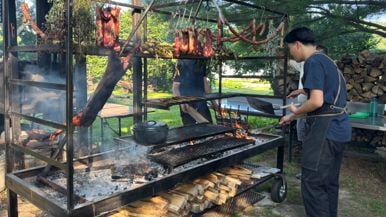
As dusk settles over Paper Kite’s regenerative farm, string lights glow beneath the trees, vegetables char over open flames and a whole miso-brined pig slowly blisters on an asado cross.
Before taking their seats for the eight-course dinner, guests wander the gardens with Hans Ning while his wife, Judy, and her crew put the finishing touches on dinner. Along the way, Hans points out beans, cucumbers and loofahs that trace their lineage to seeds Judy’s family carried across generations and continents after war forced them to flee the Mekong region of Vietnam.
Paper Kite’s Hill Tribe dinners are rooted in Judy’s Hmong heritage, but the farm reflects the couple’s shared Asian heritage. Alongside those family heirloom seeds, the Nings cultivate dozens of Asian vegetables that are rarely farmed in Ontario—things like water spinach, gai lan, sticky corn and Taiwanese cabbage. For these dinners, they grow almost everything they can. A handful of essentials (fish and soy sauces, rice) are imported.
Having traded Montreal hospitality for farming just six years ago, the Nings are steadily expanding on what they can make themselves, one season at a time. One thing they have no plans to change: guests are asked to bring their own favourite china and stemware, a tradition inherited from the farm’s previous owner that turns every dinner into a mismatched, deeply personal communal feast.
Langdon Hall
1 Langdon Dr., Cambridge, 519-740-2100, langdonhall.ca
Drive time: 75 minutes Cost: À la carte or $295 for the nine-course grand tasting menu

In 1989, Bill Bennett and Mary Beaton bought a then-91-year-old red-brick mansion on 75 acres of rolling Carolinian forest five kilometres northeast of Cambridge. Today, the estate is home to Langdon Hall, one of Ontario’s most celebrated luxury hotels and dining destinations.

Beyond the manor house lie two greenhouses, two acres of vegetable gardens, 12 kilometres of walking trails that wind through old-growth maples and black walnut, and seven laying hens that roam freely among the tomatoes and marigolds. Since joining the property in 2013, chef Jason Bangerter has made the estate’s bounty increasingly central to what lands on the plates here.
Summer menus might feature heirloom carrots with mung bean porridge; garden tomatoes dressed with tomato-water vinaigrette; or soft cheese surrounded by flowers, herbs and leaves picked just hours earlier. Bangerter has also been known to lead guests into the woods, foraging basket in hand, in pursuit of morels, ramps or even wild black raspberries, before transforming his finds into dinner.
Eigensinn Farm
449357 10th Concession Rd., Grey Highlands, 519-922-3128, stadtlanderseigensinnfarm.com
Drive time: 2 hours Cost: À la carte plus occasional ticketed events

In 1993, Michael Stadtländer (who had immigrated from Germany in 1980 and made his name in Toronto kitchens including Scaramouche) decided that city life wasn’t for him. He traded midtown for 100 acres in Grey County and became Ontario’s patron saint of farm-to-table dining long before local ingredients were fashionable. While diners were still fetishizing French imports, Stadtländer was growing, raising and foraging much of what he served at Eigensinn Farm.
The property has taken many forms over the decades, from a B&B to an event space hosting multi-course feasts under the stars. These days, Stadtländer is more focused on sculpture and rearing heritage livestock than grinding through service. The farm has evolved into something of an outdoor gallery, with sculptures scattered among its forests, fields and gardens, adding whimsy to the property. Stadtländer’s own dinners tend to be occasional special events, often in collaboration with guest chefs.

But visitors can still get a taste of farm life on weekends, when his son, Hermann, runs a wood-fired pizza program built around ingredients grown and raised on the property. Occasionally, Stadtländer joins in and adds to the weekend menu, roasting farm-raised suckling pig alongside the pizzas.
The Royal Hotel
247 Picton Main St., Picton, 613-961-2600, theroyalhotel.ca
Drive time: 2.5 hours Cost: À la carte

When chef Albert Ponzo traded downtown Toronto for the greener pastures of Prince Edward County, diners took it personally. After all, they were losing one of the city’s finest French chefs. But who could blame him? Few chefs get the chance to access produce, grains and livestock from a 680-acre property. “One of the big reasons I took the job at the Royal was because of the farm,” Ponzo says.

Owned by the Sorbara family, both the Royal Hotel and Edwin County Farm operate as a self-contained ecosystem: much of what grows—or grazes—on the organic farm makes the 20-minute trip to the hotel and its kitchens. Flowers cut that morning become centrepieces in the lobby, and in addition to providing all kinds of vegetables (rainbow swiss chard, Tuscan kale, candy-striped Chioggia beets, sweet-stemmed broccolini, heirloom tomatoes), the farm also supplies the kitchen with maple syrup, heritage grains (red fife, spelt) and dry-aged cuts of Angus beef.

This year, the Sorbaras also introduced lamb, though in quantities too small for à la carte service. Instead, Ponzo plans to celebrate the flock with occasional farm dinners where guests can eat just steps from the pastures that produced their meal. And because one ambitious livestock program apparently wasn’t enough, the family recently welcomed Martin, a Wagyu bull whose offspring will eventually produce the farm’s own Angus-Wagyu cross.
Down Home
135299 Ninth Line, Markdale, 705-446-4233, downhomerestaurant.com
Drive time: 2 hours Cost: $150 and up for a six-course lunch, $200 for dinner

After years of hosting pop-up dinners on other people’s farms, chef Joel Gray and his wife, Hannah Harradine, found a 50-acre Grey Highlands property for rent and slowly began putting down roots of their own. Since moving into the century-old farmhouse in 2019, they have transformed roughly an acre of pasture into an expanding patchwork of fruit trees, berry bushes, herbs and annual crops that increasingly supplies Down Home‘s 10-course tasting menus.

Related: This Michelin-recommended Ontario restaurant just launched a summer lunch series
Evenings begin not at the table but in the garden, where Gray and Harradine lead guests on an edible tour, passing around bites that illustrate whatever’s growing—like herb-packed “pinch salads” or fire-charred garlic scapes. Inside the red-brick farmhouse, the menu changes weekly and celebrates what Gray calls the farm’s “perfectly imperfect moments”: green gooseberries and strawberries pickled before pests can find them and bolted rapini harvested for its pepper flowers.
The dishes—like dry-aged Arctic char from Spring Hill Fish, stuffed with spruce tips and green alder, then cooked over wood coals—may be the stars of the table, but don’t overlook the table itself: each setting is thoughtfully dressed with hand-blown glassware, BC-made linens and locally crafted ceramics.

Caroline Aksich, a National Magazine Award recipient, is an ex-Montrealer who writes about Toronto’s ever-evolving food scene, real estate and culture for Toronto Life, Fodor’s, Designlines, Canadian Business, Glory Media and Post City. Her work ranges from features on octopus-hunting in the Adriatic to celebrity profiles.