“As a food scientist, I invented a way to turn insects into tofu. Now I’m shaping the future of food in less weird ways”
Turns out the mealworm-and-cricket-infused pasta sauce I dubbed “Bugognese” wasn’t very appetizing

Growing up as the youngest of three children in a conservative Jewish family in Thornhill, I kept kosher until I was 18. We couldn’t eat most things on restaurant menus, so I found myself exposed to alternative proteins from a young age. We’d go to vegan Chinese restaurants run by Buddhists, who had been serving tofu and fake meat since the ’60s, and order mock ham and mock duck. My father, a tax adviser who had worked in China in the ’90s, would talk to the servers in fluent Mandarin.
When it came time to go to university, working with food wasn’t even on my radar. I loved tinkering, so I went to McGill for mechanical engineering. Away from home, I dropped the kosher rules and began to flirt with atheism. After my first taste of Big Mac, I paused, waiting to be smote by lightning. When I wasn’t, I went on a culinary rumspringa, eating everything under the sun. In 2011, when I graduated, molecular gastronomy—a field that dives deep into the chemistry of cooking—was all the rage. I came across Jimmy’s Food Factory, a BBC show where an engineer would buy processed foods like bubblegum and reverse engineer them. That cross between science and cooking appealed to me, and I started reading culinary textbooks on my way to work building jet engines at an aerospace firm.
One day, I found a vacuum sealer on the side of the road and took it home to experiment with sous-vide cooking. I made steak first, then an octopus dish so tender I could eat it with a spoon. It struck me as the perfect intersection of food and science. Around this time, the company I worked for, Pratt and Whitney Canada, was fined for illegally selling military software to China. I became disillusioned with aerospace engineering and started thinking about pivoting to a career in food science.
In 2012, I took a bus to Montreal to hear molecular gastronomy pioneers Hervé This and Maxime Bilet speak at a conference. I wandered the room asking people how I could become a food scientist, and of course the answer was to get a degree in food science. So I applied around, getting rejected from everywhere but Cornell. One year later, I was in Ithaca, New York.
I went to Cornell to study sous-vide cooking in computer simulations, but there was only funding to study milk, courtesy of the Dairy Farmers of America. I spent my graduate career learning if it was possible to turn milk into anything besides cheese by subjecting its proteins to six times the pressure of the bottom of the ocean. The answer: yes—slightly different cheese.
In 2014, a friend asked me to join her in a competition for innovations in food security. I thought of edible insects, which were starting to gain popularity but still didn’t taste or feel like meat. I knew from my kosher days that fake crab is often made from fish, and I made a mental leap: fish aren’t so different from shrimp, and shrimp are arthropods, just like insects. Why couldn’t bugs be turned into meat too?
With this hypothesis, I built a team of Cornell students plus my brother, who was doing his MBA at Schulich. Together, we invented a way to turn crickets into coagulated blocks of protein—in other words, a bug-based tofu. To acclimatize myself to the idea of eating insects, I started sprinkling little bits of our bug tofu on all my meals, working it into burritos and ramen. We made it to the finals, which were held in Portugal, and as we prepared to travel there, we set up a stand outside a Cornell library handing out samples of our bug protein. That got picked up by the student paper and then spread across the news wires.
We didn’t win the competition, but the media attention gave us the confidence to start a company selling our insect protein technology. I knew the key would be to create a new kind of bug protein that dissolves in water. Most of the insect protein out there is just dried up bugs. It’s like cooking with sand, and you can only put so much sand in a muffin.
In 2015, my brother and I took our bar and bat mitzvah savings, got some seed investment from family and founded C-fu Foods—“C” for cricket and “fu” for tofu. I also worked a teaching gig at Cornell, and I split my time driving between Toronto and Ithaca every week. We rented out a commercial kitchen in Toronto to make our bug tofu, which I fed to John Tory when he came for a tour of the facility. He was a good sport.
After about a year, I realized that we had branded ourselves terribly. “C-fu” made no sense, and our logo was a circle with “fu” in it, which looked like it was telling potential customers to fuck off. We hired some actual marketers and launched a new company, One Hop Kitchen. We developed a mealworm-and-cricket-infused pasta sauce we dubbed Bugognese and served it at trade shows across Toronto, the US and the UK. At least 10,000 people tried our bug sauce.
By 2018, we had met just about everyone in the bug industry, but our sales were slim. Then a Dutch company called Protifarm reached out to us. They had spent millions building a fully automated insect farm in the Netherlands and needed a way to process as much as 10 tonnes of mealworms a day. My brother and I pitched them on our protein processing technology. It’s difficult to ship bugs around the world: not only do they have to be kept cold, but most countries don’t have customs codes for edible insects. So instead of having Protifarm ship us the mealworms, I flew to the Netherlands to show them how the technology worked.
We came to a deal with Protifarm that involved me moving to the Netherlands and working at their factory. I lived in a small town called Amersfoort and helped build a scaled-up production line making textured insect proteins. I had a bit of experience in industrial environments, but really, I had no idea what I was doing. I spilled boiling water on myself and couldn’t walk for three weeks. One day, I was driving my little Citroen SUV to a lab in Germany with 50,000 live meal worms in open-topped green bins in my trunk. I misread a sign at an intersection and caused a collision. Everyone was okay, but the worms were not. Counting them, it had to be the deadliest car crash in German history.
Everything came to a head in December of 2019, when we showed off our insect burger at Food Ingredients Europe, a trade show in Paris. By that time, the insect industry was riding some tailwinds, but I was getting tired. Long days of lifting buckets of bugs had thrown my back out, and I worried that working in the insect sector was isolating me from the rest of the industry. Plus, I missed my wife, who had stayed back in Canada, and we wanted to start a family.
Thankfully, I was in Canada when the pandemic grounded flights. I exited the bug business and got a job doing R&D at Maple Leaf Foods, where I helped develop plant-based dairy products, low-sodium lunch meats and recyclable packaging. My wife and I got a dog, and we found out she was pregnant in April of 2020. I decided to come out as trans in the months leading up to my daughter’s birth. My wife had known for years, but I realized that if I was going to have an honest relationship with our child, I’d have to be honest with myself as well. In late 2020, I went “on tour,” coming out to everyone in my life. It went pretty well. Our daughter, Eve, was born in February of 2021.
In the years that followed, I had various roles at Maple Leaf, from corporate strategy to marketing, finally becoming their innovation director. Today, my job involves spending time in grocery stores and working with my team on what the next hot dog will be. Maybe it will be a version you can eat 10 of at a barbecue without feeling sick, or a version with 15 milligrams of caffeine to keep you alert at a Jay’s game.
The future of food is fascinating. With climate change threatening crops, we’re going to see coffee and chocolate alternatives: someday, your cup of joe may be made with coffee flavouring and roasted hazelnuts. Overfishing could force us to eat lower-impact fish, like Atlantic croaker. And there’s lots of exciting work on GMOs: Canada just approved a new breed of pig with immunity to the common cold, which could save the meat industry a billion dollars a year.
I never wanted to be the bug gal forever, so I’m happy to be expanding my horizons. I’m eager to accelerate the adoption of food tech in Canada, and I’d like us to become an exporter of some key technologies. These days, most innovation in food science happens in the Netherlands, the US and Singapore. Selfishly, I want the Canadian food tech industry to grow so I can have a meaningful career in it. This industry is a huge, beautiful machine, and I’m happy to be a cog in it.
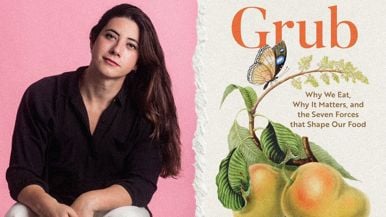
Lee Cadesky is a food scientist, inventor and innovation director at Maple Leaf Foods. She is the author of Grub: Why We Eat, Why It Matters, and the Seven Forces that Shape Our Food (Prometheus Books, 2026) and writes at The Digest Digest on Substack.