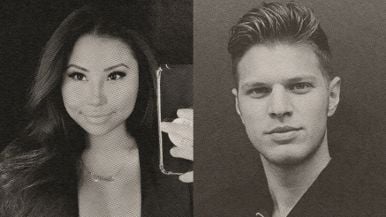
For $200,000, this director transformed his art deco loft into a live-in film set
Goodbye, Crayola colour palette, warped floors and frumpy fabrics. Hello, airy hardwood, stone slabs and lighting to die for

The Place
A 1,650-square-foot, two-bedroom, two-plus-one-bathroom live-work hard loft in an art deco former warehouse near Fort York.
The History
For years, director Justin Wu was obsessed with the Tip Top Lofts on Lake Shore, combing through old listings and memorizing floor plans until he narrowed his interest to just four units. When one of them surfaced on Facebook Marketplace in September of 2024, Wu lobbed a lowball offer. Even though the unit was in rough shape, the seller asked for an additional $500,000. At the time, Wu had just landed his first Hollywood project (a rom-com called Sidelined starring the late James Van Der Beek), so he knew he’d soon have the funds to close the gap.
Wu and the seller eventually struck an unorthodox off-market deal: he’d close by the summer of 2025 or would start covering the seller’s mortgage until he could. He also sweetened the pitch by telling the owner not to fix a thing—the damage, the debris—and price it accordingly. By May of last year, the unit was his.
A six-month, $200,000 renovation followed. The double-height unit—with its Crayola-coloured accent walls, warped maple floors, industrial ductwork and frumpy blackout curtains—was a cosmetic disaster, but the bones were what Wu had fallen for. So he hired interior designer Phoenix Grey to pare it down and highlight the split-level layout. Rebuilt in pale wood, monolithic stone slabs and carefully controlled lighting, the space now functions as both home and set, equally suited to after-parties, shoots and displaying art.
Related: How a $1-million reno transformed a frilly Rosedale mansion into a “home for adults”

The Tour
Wu and his team ripped everything down to the studs, then started by soundproofing the walls and floors—essential for someone who regularly hosts dinners and screenings. Gone are the honey-hued flooring and brightly coloured accent walls, replaced by a neutral Japandi palette. The feature wall behind the mounted flatscreen was bi-coloured (grey on the bottom, white on top), which visually shrank the space. In its place, a wall of vertical white-oak slats draws the eye upward, amplifying the room’s height rather than cutting it in half.


The previous set-up leaned crypto-bro frat: a hanging basketball hoop, a mishmash of oversized furniture. Wu kept the open-concept layout but upgraded the cast, swapping in more sculptural pieces, including an espresso custom sofa set made by Ficari, a Noguchi coffee table and an Eames lounge chair. Grey urged him not to toss the stone offcuts from the kitchen and washrooms so that they could be upcycled into side tables and plinths—an economical move that also helped tie the living area together with the home’s heavily stone-clad wet spaces. “It wasn’t about being frugal,” Wu says. “It was about not being wasteful.”


Wu loves how the unit’s 24-foot ceilings make the living and dining zones feel far larger than their footprints. “The ceiling height, not necessarily the square footage, creates a sense of vastness,” he says. Less charming was the exposed steel ductwork that once muscled its way through the living room, bisecting the view. That’s now gone, replaced by a displacement ventilation system that’s hidden in the walls. Those two black holes on the white pillar near the window are the only traces of the HVAC system.


While the exposed ductwork was part of the building’s original retrofit, the previous owner had only added to the visual noise with a clunky chandelier dangling from an eight-foot black chain. Wu wanted uninterrupted sight-lines, so he got rid of it. In its place, he installed a single wall-mounted fixture—sourced from Etsy, customized by Wu—that extends out over the dining table, its hardware painted white so that it all but disappears. In the living area, the lighting is almost invisible: Philips Hue strips and discreet fixtures are hidden behind the TV, creating an ambient wash of reflected light. You don’t notice the sources so much as the effect, which Wu can tweak for brightness or colour with the tap of an app.

The kitchen was a time capsule of early aughts condo core: red-toned wooden cabinets, black granite counters and frosted-glass uppers. Grey kept the island but scaled it up, turning it into a proper anchor for the space. The warm palette was replaced with creams and whites: pale-oak storage and Taj Mahal quartzite surfaces.


When Wu took possession of the loft, the appliances weren’t just tired—they were barely working. The microwave was even missing its door. Everything has since been upgraded to Monogram (“The Ferrari of appliances,” according to Wu). To keep the kitchen visually quiet, most appliances are concealed behind oak millwork.


As for the powder room, its teal walls and dark floor made the compact space feel tighter than it already was. Now, it’s reset in travertine and white. Bands of textured Japanese glass blocks bookend the room, borrowing natural light from the living room and, when the sun hits just right, even carrying rays through to the foyer.


Formerly an office, this is now Wu’s all-in-one creative zone: a piano room, a photo gallery (he shot those ballet vignettes while living in Paris), a vinyl archive and, thanks to a pull-out backdrop, a photo studio. The indigo wall is gone, the track lighting is upgraded and a custom white-oak sideboard adds some much-needed storage for Wu’s approximately 300 LPs.


The second-floor hallway has been converted into another gallery space. Those oversized prints, roughly three and a half by five feet, are also Wu’s own photographs. The heavy black track lighting was replaced with gallery-calibre spotlights.
Throughout the loft, clunky aluminum-and-glass railings once lined the upper-level bedrooms and hallways. Because of the split-level layout, the unit’s two bedrooms don’t fully enclose; they open onto the living area below, more like interior terraces than traditional rooms. By replacing the railings with glass, Wu gave the loft a cleaner, uninterrupted flow.


Here’s a look inside the main bedroom, which has been upgraded with a wall of white-oak built-ins.

The original ensuite was more murky than moody. Wu leaned into the darker theme, pairing olive walls with undulating Japanese finger tiles and matte-black fixtures. “I didn’t want it to be super bright,” he says. “In the morning, that kind of light is jarring.” There are still overhead pot lights, but Wu prefers an ambient glow that rakes across the surface and brings out the tiles’ wabi-sabi irregularities.


Here’s the former secondary bedroom, recast as an office. The couch does pull out, though, so it can still function as a guest room. This is also where Wu displays his film and TV memorabilia.


Finally, let’s head to the second upstairs bathroom. The original was a colour free-for-all (coral and moss green walls, white tiles, beige flooring) paired with a strictly functional, thoroughly un-beautiful tub and shower. The renovation is spa serene: walls wrapped in vertically stacked kit-kat tiles, a floating vanity and soft integrated lighting. And just out of sight is a brand-new soaker tub.


Stoked about your staging? Recently finished a renovation? Send your story to realestate@torontolife.com.

Caroline Aksich, a National Magazine Award recipient, is an ex-Montrealer who writes about Toronto’s ever-evolving food scene, real estate and culture for Toronto Life, Fodor’s, Designlines, Canadian Business, Glory Media and Post City. Her work ranges from features on octopus-hunting in the Adriatic to celebrity profiles.