Wildfire smoke continues to make Toronto’s air quality “very unhealthy”
Many are questioning why Premier Doug Ford cut Ontario’s emergency forest firefighting budget

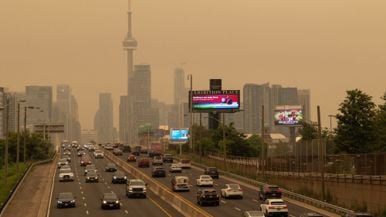
Toronto’s air quality remains terrifyingly poor today, with smoke from wildfires in northwestern Ontario continuing to cover the city.
Environment Canada’s orange warning is still in place, and the agency is advising the general population to “reduce or reschedule strenuous activities outdoors, especially if you experience symptoms such as coughing and throat irritation.”
The air quality has been labelled “very high risk,” with tomorrow’s forecast dropping down to “moderate” and “high.”
According to IQAir, Toronto’s air quality is the world’s third-worst today, with a score of 296, making it “very unhealthy”—the platform’s “hazardous” category begins when the index reaches 301, which Toronto is close to. Yesterday, IQAir showed Toronto as having the worst air quality in the world.
Related: Doug Ford is doubling down on his plan to seize land to expand Billy Bishop airport
Health recommendations from IQAir include avoiding outdoor exercise, keeping windows closed, wearing a mask outdoors and running an air purifier inside.
Many city activities have been cancelled or modified due to the smoke. Outdoor swimming pools have been closed, and yesterday’s FIFA Fan Festival was cancelled, as was the World Cup broadcast at Nathan Phillips Square. (Indoor pools and recreational facilities are open.) In northwestern Ontario, several communities have been evacuated due to fires.
Premier Doug Ford said on social media that, “Our government will not spare a penny to keep people safe,” noting the province’s investment in forest firefighting capacity.
Many were quick to point out that the province has actually budgeted less for emergency forest firefighting, even though past Ontario summers have also contended with forest fires and resulting air quality crises. Last year, Ford cut Ontario’s emergency forest firefighting budget from $177 million to $135 million.
“A realistic base budget would allow the ministry to recruit and retain crews, maintain aircraft, secure equipment, and prepare evacuations before communities are threatened, rather than scrambling once fires are burning and families are being forced from their homes,” Ted Hsu, the Ontario Liberal critic for Rural Affairs, Natural Resources, Mining and Forestry, said in a statement.
Jeffrey Siegel, a University of Toronto professor who specializes in air quality research, told CBC that provinces and municipalities must do more to prevent health risks related to wildfire smoke. “I believe that this is the new normal. The data shows that very, very clearly,” he said.
Related: Last week’s heat caused nearly 40 emergency room visits

Carly Lewis is a journalist whose work has appeared in the New York Times and the New York Times Magazine, Vanity Fair, Wired, Interview Magazine, Pitchfork, Elle, and Maclean’s, where she is a contributing editor. Her work has been recognized by the National Magazine Awards and the Digital Publishing Awards. She reports on city life, culture—including what people do online—politics, art and crime. She received the Dave Greber Freelance Writers Award for “The Murder of Ashley Wadsworth,” an investigative feature about a Canadian teenager who was killed by a man she met on social media, published by Maclean’s.