Editor’s Letter: What people will do for a little (or large) piece of cottage country
How much luxury can Muskoka sustain before it loses the natural beauty that drew wealthy cottagers in the first place?

In the documentary Marty, Life Is Short, Martin Short sits under a cloudless sky on his Muskoka dock and ponders the afterlife. “I always thought, if heaven existed, then maybe heaven is your favourite place in eternity,” he says. “And that would be this place.” The film is a delight, not just for its grainy camcorder footage of Eugene Levy flipping burgers and Catherine O’Hara flinging a frisbee but in how it presents a simpler, forgotten era in Muskoka’s history.
Short was one of the first big names to discover the tranquil beauty of Muskoka, and for that he can’t even take credit: his late wife, Nancy, bought their stone cottage more than 30 years ago, without him having seen it. Their famous friends came to visit, and before long, word had spread about the glimmering lakes north of Toronto. Kurt Russell and Goldie Hawn soon bought, as did O’Hara.
In the years before and after, other factors turbocharged the appeal of the region: the extension of Highway 400 north to Parry Sound in the 1990s helped shave down commute times; savvy marketing by Destination Ontario spread the gospel; and the pandemic turned everyone positively batty for cottages. But nothing did more than celebrity testimonials. In April, Kate Hudson called it “the most special place in my heart.” Dax Shepard, whom Hudson dated in 2007, spoke about it with reverence on Armchair Expert. David and Victoria Beckham have been well documented wakeboarding on Lake Joe, joining the legions of other fawning interlopers, like Justin Bieber and Shaquille O’Neal.

In cottage country as in the city, where the cool kids go, the money soon follows. Garbage king Patrick Dovigi owns a slew of properties on Lake Joe; Colliers CEO Jay Hennick has erected a shimmering glass compound nearby. Don Walker of Magna has a place. So does Robert Herjavec. Kevin O’Leary, to his credit, has been there for decades.
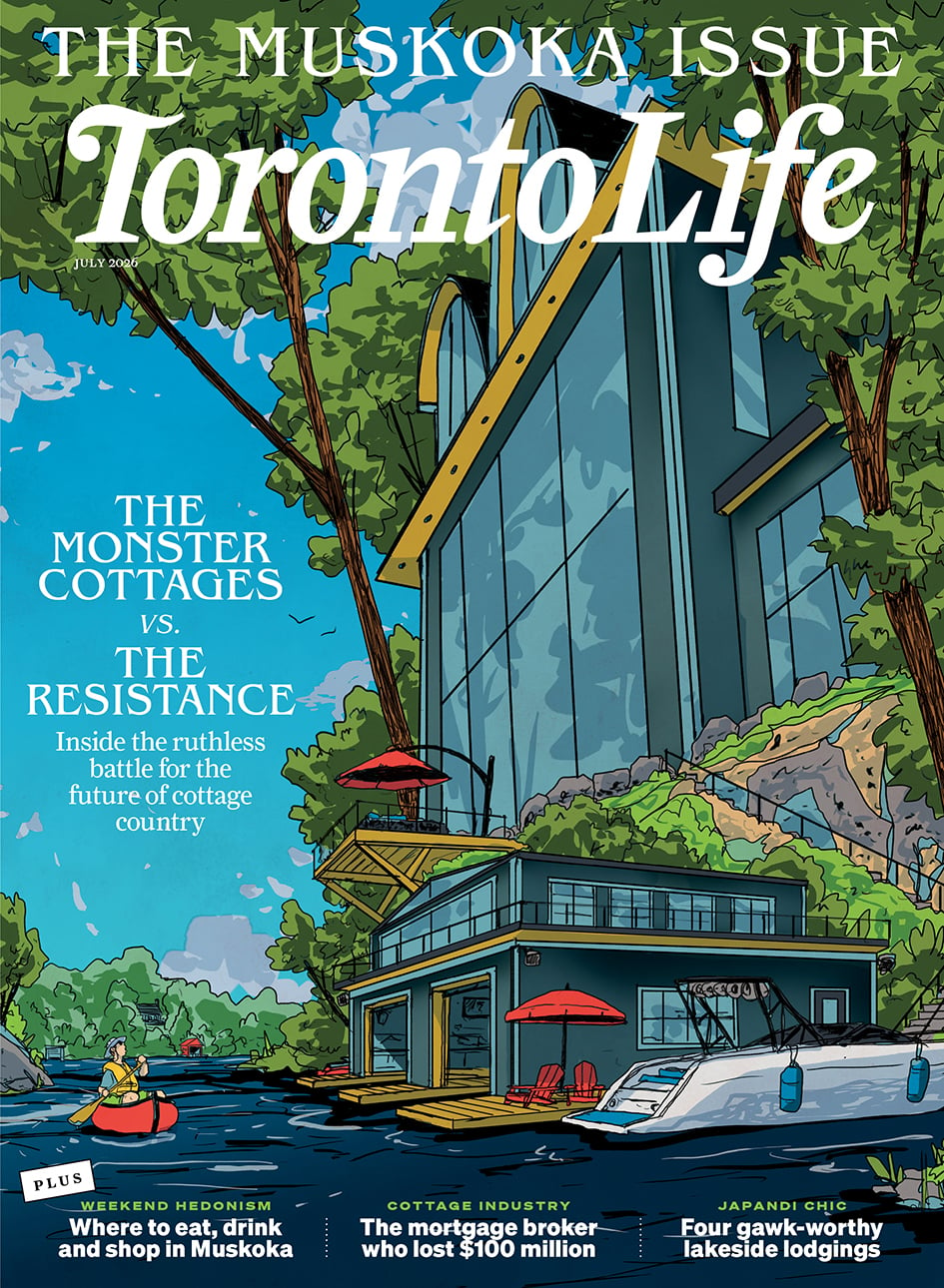
The influx of wealth isn’t intrinsically bad. After all, wealthy people enjoy waterskiing and caesars on the dock as much as anyone else. And the business they bring is a boon for the local trades and retail economy. Where matters get tricky—and occasionally explosive—is when construction projects go steroidal and threaten the natural beauty that made Muskoka such a draw in the first place.
The cover story for our first-ever Muskoka Issue swan-dives straight into the fray. It’s written by one of Toronto Life’s editors, Charlie Wagner-Chazalon, who grew up in the area. He spoke to the folks who want to build whatever they please and are accustomed to getting their way. He also interviewed the by-law officers, local politicians and environmentalists who together constitute a ragtag resistance. The odds are stacked against them. The Township of Muskoka Lakes, for instance, has a small staff, a tiny budget and only one boat, which by-law officers have to share with other municipal employees.
The latest controversy involves a Russian Canadian businessman who wants to build a mega-resort featuring overwater huts, two restaurants and parking for 2,500 vehicles. His plans have nearby cottagers in an absolute tizzy. They see it as symptomatic of the same problem: big money, be it commercial or residential, throwing its weight around, consequences be damned.
In the doc, Short describes Muskoka as the kind of place where “even if you haven’t been here for a year, you feel like you haven’t left.” As the piece makes clear, many cottagers fear that sentiment may be fleeting.

Malcolm Johnston is the editor-in-chief of Toronto Life, a role he took on in 2022 after 11 years at the magazine. He has worked as a writer and features editor, with a strong focus on investigative journalism and in-depth reporting on the people, politics and culture shaping Toronto. He is the author of a forthcoming narrative non-fiction book about the double life of Jeffery Shuman, the serial bank robber known as the Vaulter Bandit.