Editor’s Letter: This month, TIFF brings home the magic of the movies
Now in its 50th year, the Toronto International Film Festival turns the entire city into one big red carpet

My first major celebrity interview as a young journalist was with the actor Scott Speedman during the 2010 Toronto International Film Festival. He’d become famous as the heart-throb opposite Keri Russell in Felicity and had gone on to act in Barney’s Version, the Underworld series and Vin Diesel’s xXx: State of the Union. Now he was awaiting me and my tape recorder on the other side of a hotel room door at the InterContinental on Bloor. I took a deep breath and walked in.
Related: The biggest celebrities coming to Toronto for TIFF 2025
Other than watching the screener for his film, Good Neighbours, a serviceable noir mystery starring Emily Hampshire and Jay Baruchel, I’d skipped any real prep work. I was under the impression that the best interviews were candid and free-flowing, an alchemical reaction between two people trading spur-of-the-moment ideas and searching for common ground. So I shook his hand, sat down and lobbed a breezy opener, something like: “What was it like making this film?” He answered pleasantly, professionally, succinctly, and nodded as if to cue the next question. The problem: I didn’t have one. Chemistry, by this point, was supposed to have taken hold and thrust us into a conversational flow state. Desperate for help, I glanced at my notepad, which was blank. I blinked rapidly at Speedman. Then I gathered my things, thanked him for his time and walked out past a confused publicist—24 of my 25 minutes remained—and into a rapidly forming mental prison of mortification.
I bring up this memory for three reasons. One: it makes me laugh every time I think about it. Two: it serves as a kind of personal cautionary tale—never again did I show up to an interview unprepared. And three: it says something about the fantastical hold movies and actors have on all of us. I entered that room with such cocksure eagerness because, subconsciously, I felt like Speedman and I were already acquainted. I had watched him on screen for enough hours to know his mannerisms, his facial tics, the preppy-hippie timbre of his voice. In other words, we were already friends; now we were finally hanging out. I exaggerate, of course, but only slightly. Movies have this effect on us: they capture our imaginations and invite us to get swept away in a story that feels so real it essentially is.

Every fall since 1976, Toronto has transformed into a portal to this magic. Our city, in all its post-summer glow, comes alive for 11 incredible days as our streets, restaurants and cinemas are filled with actors, directors, producers and distributors—all united by the love of putting stories on film.
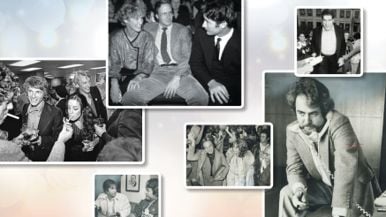
This year is TIFF’s 50th anniversary, and we’re marking the occasion by devoting all four of this issue’s features to the movies. That begins with a tour through TIFF’s first half-century, with stories about the biggest deals, juiciest scandals and most mischievous icons. We then profile Matt Johnson, a director who straddles cult comedy (Nirvanna the Band the Show the Movie) and mainstream fare (BlackBerry; the upcoming Bourdain biopic, Tony) like no one else. We also get to know the next generation of filmmakers—the self-titled Canadian Queer Mafia. And we bring you a conversation with Ryan Reynolds, the ultimate multi-hyphenate, conducted by Courtney Shea, who needed no reminders to prepare for the interview.
Whether you’re a hard-core cinephile, a dabbler or an earnest young journalist looking to absorb some stardust, movies hold a special place. For 50 years, TIFF has brought the magic so close you can touch it. Here’s to the next 50.
Malcolm Johnston is the editor of Toronto Life. He can be reached via email at editor@torontolife.com.

Malcolm Johnston is the editor-in-chief of Toronto Life, a role he took on in 2022 after 11 years at the magazine. He has worked as a writer and features editor, with a strong focus on investigative journalism and in-depth reporting on the people, politics and culture shaping Toronto. He is the author of a forthcoming narrative non-fiction book about the double life of Jeffery Shuman, the serial bank robber known as the Vaulter Bandit.