Robby on the Line
Larry David is the indisputable king of brutal honesty. But if anyone comes close, it’s Robby Hoffman, the suddenly everywhere comic from whom no group is safe: gays, straights, Jews, gentiles... Out and about with comedy’s equal-opportunity assassin
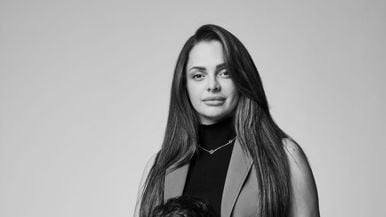
A lot of things make Robby Hoffman sick. Businessmen who wear quirky socks. Pit bulls. People who clip their toenails on the couch. Thirty-something men who say, “That’s so fire.” The very thought of attending a Pride parade. Orange juice with pulp. Potlucks. She may come across as a misanthrope, but Hoffman, who believes that “to complain is to enjoy,” is living her best life. Like observational cringe-comedy king Larry David, to whom she’s often compared, the “small, ex-Hasidic queer comedian” (per her talent agency’s official bio) has developed an onstage persona that seems to be an absurdly heightened version of herself. IRL, she’s barely even a curmudgeon: she’s warm and neurotically attentive. But get her behind a mic and the kvetching comes out. Whether or not Hoffman is actually disgusted by the world isn’t the point. The point is to subvert expectations—sometimes deliberately, often inadvertently, simply because people have preconceived notions about her beliefs based on who she is on paper.
Her shtick has struck a chord. Hoffman, who found her comedic footing in Toronto, has been a known quantity in stand-up circles for more than a decade, but over the past year she’s added de facto TV star to her resumé. Last spring, Hoffman had small but mighty roles in a pair of prestige dramedies. In Hulu’s Dying for Sex, she played G., a retail worker who matter-of-factly encourages Michelle Williams’s protagonist to explore BDSM. In HBO’s Hacks, she played Randi, a guileless talent agency assistant who, like Hoffman, is gay and has roots in the Brooklyn Lubavitch Jewish community. Both characters are avatars of Hoffman herself, whose performances caught critics and viewers off guard. The New York Times proclaimed, “If you put her in a scene, she will steal it.” A month later, Hoffman did appear as herself on Netflix’s Everybody’s Live With John Mulaney. Mulaney, who has described Hoffman as “the most interesting person in the world,” promptly returned the favour: he signed on to direct Hoffman’s Netflix stand-up special, Wake Up, which premiered in December. Wake Up is polarizing: on Letterboxd, where it has an average rating of 3.5 out of 5 stars, reviews range from “Absolutely love whatever’s wrong with her” to “Someone recommended this special to me and now I will never trust them again.”
Related: Lady Parts—Inside Meredith MacNeill and Jennifer Whalen’s new show, Small Achievable Goals
Hoffman is a kind of comedy Rorschach test: your interpretation of her material reveals more about you than it does about her. Depending on where you stand, the title Wake Up can be read as either a cri de cœur in a world that has lost its moral bearings or a wry jab at the woke masses. Hoffman opens by addressing her audience with a homophobic slur, touches on how every man is “a little bit gay,” delivers an extended bit about pedophilia, riffs on abortion and then makes a beeline for gender-neutral pronouns. It’s charged, confrontational stuff. In addition to Larry David, Hoffman is often likened to ’80s provocateur Andrew Dice Clay, who made his name by milking oily, over-the-top chauvinism for laughs. But, where the Diceman deployed sexism for sheer shock value, Hoffman tackles divisive subjects in a way that elicits both laughs and mounting discomfort from people on both ends of the political spectrum. It leaves enough ambiguity to make you question where she truly stands.
Nearly two decades ago, Christopher Hitchens notoriously explored “Why Women Aren’t Funny” in Vanity Fair. Today, it’s clichéd to critique comedy as a boys’ club, but it has become the site of a tug-of-war between progressive voices and crusaders against so-called cancel culture. For a certain old-guard contingent, the end always justifies the means: if you get laughs, all kinds of questionable behaviour can be forgiven. But, after revelations about predatory sexual behaviour (temporarily) derailed the careers of celebrated funny men such as Louis C. K., and after Dave Chappelle’s public shift from searing racial satire to base transphobia alienated many fans, traditionalists were rattled. While Jerry Seinfeld opined that he and his brethren were being muzzled by “the extreme left and PC crap” (a statement he later walked back), the people who were accustomed to being the butt of the joke celebrated a long-overdue reckoning. This factionalism comes with pressure to pick a side, but Hoffman is first and foremost a numbers guy—before she was a comic, she was training to be an accountant. From that vantage, her MO of plausible deniability is a savvy business decision. Choose righteous indignation and you’ve alienated the masses, but a tactless slip-up could land you in the doghouse. The facts of who she is make Hoffman a novelty, but she has no interest in defaulting to identity politics. Her shell game is strategic: keep people guessing and they’ll come back for more.
If Hoffman’s sensibility is Larry David meets Popeye—part kvetchcore, part “I yam what I yam”—her aesthetic is Larry David meets Olive Oyl. Her polos, oversized button-downs, baggy sweatshirts and Obama jeans radiate a vibe that’s more “impatient boyfriend checking his watch” than “shops for fun.” But, again, appearances are deceiving: that get-up is carefully curated. (There’s a reason the New York Times counted Hoffman among the 67 most stylish people of 2025.) Fittingly, when I asked what she wanted to do during one of her rare free hours in Toronto, she suggested that we meet at a vintage clothing store. There’s no trace of that onstage prickliness in our real-world interactions. When she was running a few minutes late, Hoffman sent me a string of assiduously apologetic texts. She arrived in a black Prada puffer jacket, carrying a Prada-branded pouch—the latter a slick knockoff Hoffman had just bought for her friend, Toronto comedian Natalie Norman, she was quick to clarify, but the former long-coveted and legit. Together, they’re a neat metaphor for where she’s at: successful enough to afford designer drip, forever hustling for a good deal.
Hoffman was raised on other people’s cast-offs. Growing up as the seventh of 10 kids, the comedian never had anything new. If she wasn’t wearing hand-me-downs, it was something from Value Village that smelled of mothballs and other people’s bodies. Always used, never vintage. The rare occasion when she’d get, say, a fresh cotton bralette from Zellers was the height of luxury. Even now, new stuff is aspirational and a little alien. Hoffman has a bit about it in her Netflix special: “Ever realize you grew up poor because you like a hard towel?” she asks, recounting a visit to a friend’s pool, where she was put off by the fresh, fluffy linens. “They’re selling these?” she balks. “To me, a towel is built with the house.”
Related: “Canadian comedy is some of the best in the world”—Comedian Vic Michaelis wants to be a hometown kid
On the surface, her upbringing could be fodder for a modern-day Mordecai Richler book. Born Rivkah Sarah Hoffman, she was raised alongside four sisters and five brothers in Montreal’s Côte-des-Neiges neighbourhood by a hearing-impaired single mom who hustled to make ends meet. There were beds in hallways, a constant racket and never enough popsicles to go around. Hoffman’s mother had eschewed her parents’ more progressive version of Judaism in favour of a traditional sect, and she ran an Orthodox household. Hoffman managed to keep kosher until her late teens, when she succumbed to a fit of exam-time hunger and devoured an Egg McMuffin.
She is practised at turning the broad strokes of her biography into punchlines. For instance, her mother’s religious choices stem from, as she puts it, “an addiction to cults.” But, even as she moves toward the next beat onstage, there’s an instinctive protectiveness—you’re allowed to laugh in empathy, but crass mockery is off the table. (Wake Up includes a rare exception, an extended riff on her mother’s appalling public-washroom habits.) Certain details, though, don’t make it into her act. Her mother and father, who met in yeshiva in the late 1970s, had an extremely volatile marriage. Hoffman and her siblings were born in Crown Heights, Brooklyn—all within a 12-year span—where the insularity of the cloistered Hasidic community intensified an already tenuous situation. Eventually, Hoffman’s maternal grandfather managed to convince his daughter to move to Montreal, but not before Hoffman witnessed a lot of violence. From that point on, she was largely estranged from her dad, who she’s said opted to spend his money on Porsches instead of paying child support. Today, they don’t have a relationship to speak of, but when I ask Hoffman about the origins of her unremitting belief in herself, he comes up. “This is where I’m reminded that I’m like both my parents,” she says. “The few times I’ve met with him, I go, Oh, there’s a whole missing half. He’s very boisterous and funny.”
Comedy, Hoffman has said, is a cathartic way to process the “nightmare” of her less-than-idyllic upbringing. But the filth and chaos are what shaped her sensibility. Her mother loved movies, so Hoffman and her siblings grew up watching whatever videos they could borrow from the public library. “We watched Spike Lee early,” she says. “We were soaking up a lot of stuff that most kids wouldn’t have picked up at Blockbuster.” Unsurprisingly, the household was full of big personalities. “I think people see Robby and they’re like, ‘Oh, she’s a character,’ but she’s likely not even the biggest character in her family,” says her friend Natalie Norman, the recipient of the faux-Prada pouch; back when they were vying for time in Toronto clubs, the two bonded over their shared experiences as younger siblings in sprawling Jewish broods. Hoffman maintains that her brother Shmuel is the funniest person she’s ever met. When I ask her to elaborate, she encourages me to watch the 11th season of Canada’s Worst Driver, on which Shmuel and one of her other brothers, Sholom, made the semi-finals. “They applied for it because you got $2,000,” she says. “But we’re city kids—we took the Metro! We don’t know how to fucking drive.”

When Hoffman was a teenager, her grandfather got her a subsidy to attend a private Jewish high school. “It was me and four Russian kids,” she says. All her new friends came from much more privileged backgrounds, but Hoffman was happy to visit their country houses and watch videos while they went skiing. In exchange, she was “the mouthpiece.” At 16, Hoffman and her crew would “get slutty” and head to the W Hotel in downtown Montreal, where they’d heard hockey players hung out. “I’d walk up to any table and be like, ‘Hey, fellas, what are we drinking?’ ” Hoffman says. As teenagers, they couldn’t believe so many men were eager to ply them with free booze. “Looking back, I’d believe they were all pedophiles.”
Even as she flirted with bougie culture, Hoffman resigned herself to being a have-not. She initially assumed that university was out of the question since familial tuition support was a non-starter: her mother couldn’t afford to pay for one kid, let alone 10. Unfazed, Hoffman applied to McGill, the cheapest of all her options, and landed a scholarship to study accounting and communications. Her objective was to find a sensible route to a high-paying job. “I didn’t have anything. I thought I wasn’t going to be able to go to school and I wasn’t going to get a licence or a car, whatever all these other kids had,” she says. “Then I was like, Rob, we don’t have nothing. We have very close to nothing. But I do have me. Maybe I could do something with that.”
Objectively speaking, there’s nobody quite like Hoffman in stand-up. Getting the short end of so many power dynamics—poverty; queerness; Orthodox Judaism; a gender presentation that suggests, as she puts it, that “something has gone awry”—may be a bummer in day-to-day life, but it exponentially increases her options for punching up. Hoffman clued in to that opportunity early. “Most people are battling to find self-love,” she says. “That was the only thing I had. I kind of liked me. Even when I realized I was gay, I didn’t think God didn’t like it. I thought God probably fucked with it. I thought people would think it was terrible. But I didn’t think it was wrong.”
Hoffman’s entry into stand-up was part whim, part compulsion. The Just for Laughs comedy festival was a Montreal institution. Buying tickets was out of the question, so she soaked up whatever she could find online. “I always loved comedy, but I never saw myself as an entertainer,” she told comic Marc Maron on his podcast. “I just knew I had things to say, and I had a way of saying it. I wanted to have the freedom to say whatever the fuck I wanted.” After finishing her undergrad, she secured an internship at KPMG, a position that came with a regular paycheque, a laptop and a powerful sense of security. From nine to five, she was Rivkah the auditor, but at night, she was Robby, shooting her shot at open mics and clubs run by 50-something creeps who would cajole her to bring her friends in exchange for stage time. The new name was a precaution: she was worried that her accounting firm would think she wasn’t “diehard” enough if they found out she had a side hustle. (Those worries were for naught. When one of the partners happened upon a review in the paper, he asked Hoffman if she’d do a set at the company Christmas party.)
Related: North Stars—An unfettered roundtable with CanCon’s queer mafia
When Hoffman was starting out, she kept hearing that it takes 10 years to find your voice—but hers was clear from the jump. Still, it took her a moment to perfect it. In the early aughts, Hoffman could be found in the basements of clubs on St. Denis, looking like a baby-faced Bar Mitzvah boy in suits she’d bought for her office job. During one set, her biggest laugh was a cranky bit about the “man cleavage” sported by a poster boy in a community college ad on the Metro. Over the next few years, she sharpened her focus. You can hear hints of her Wake Up material in a set from 2015, including a double-edged bit about straight men’s girl-on-girl fantasies (“I have a hunch that I’m not one of the lesbians these men are dreaming about”). At one point, she drops a casually pejorative use of the word “Jew,” then leaves an extended beat for the crowd to decide whether it’s okay to laugh. Then as now, Hoffman was looking to push buttons, but her motivation has never been shock value alone. If a subject is in her purview and she gets the sense that it’s off limits, she feels more drawn to talking about it. By framing, say, Anne Frank’s attic as remarkably spacious compared with most contemporary rentals, she’s yanking something out of the realm of the sacred and bringing it into the here and now.
By default, stand-up comedy typically involves a kind of self-caricature. To distinguish yourself from the other bozos sharing pithy observations and petty affronts, you hit the audience with exaggerated versions of your most distinctive qualities. But a gifted comic can twist those preconceptions and lob them back in a way that forces the audience to reckon with their own biases—a conceptual version of the “I’m rubber, you’re glue” schoolyard chant. If you beat your haters to the punch, you have the power.
Hoffman is familiar with the cost of losing a narrative battle. In her late teens, she was inadvertently outed when some classmates caught her making out with her secret girlfriend. For some of Hoffman’s more conservative Jewish friends, being gay wasn’t kosher. The revelation upended her social life. The only option was to wrest back control. By leaning into the characteristics that made her a curiosity, Hoffman could command attention; by challenging assumptions, she could catch people off guard and assert her claim to space. “My comedy is unique,” she told an interviewer in 2019. “I’m the only person who could say my comedy.”
At the end of Wake Up, after everything fades to black, an aphorism floats into the middle of the screen: “Truth told, the odds are not in your favour, but that’s what will make it such a good story.” (Per the chyron below, the comedian saw the quote on a mailbox; it obviously struck a chord.) Hoffman may have had nearly nothing, but she had herself. She had her story. Given that, it’s perhaps not surprising that she’s relentless about maintaining control over it. She knows her IP is her greatest asset—why wouldn’t she guard it with her life?
The Montreal scene was small enough that Hoffman quickly ran out of runway. She was determined to pursue her calling as a comic; the logical next step was to move to Toronto, which promised a fresh start, more opportunities and the possibility of branching out into TV writing. “Everyone in Montreal told me that Toronto sucks,” says Hoffman. “But, when I came here, I started doing shows right away, and they embraced me. It was a city that worked.” She became a regular at Comedy Bar and developed a following among other comedians. “A lot of people respected her,” says Norman. “Robby couldn’t be anything other than herself. It made people comfortable.”
Comedy may have been her passion, but Hoffman refused to risk her steady KPMG paycheque for anything less than a sure thing. To manifest that destiny, she wasn’t above resorting to the occasional hare-brained scheme. After writing a spec script, she posed as a courier so she could deliver it directly to the president of HBO Canada. Against all odds, that script landed her an option deal and an agent, who then got her an interview for Odd Squad, an educational TV show for kids. From the outside, it may seem like a bizarre fit for a stand-up with R-rated tendencies. But the show, which was co-produced by Toronto-based Sinking Ship Entertainment, was the overlap in the Venn diagram of Hoffman’s two skillsets: jokes and math. When she first met her new bosses, Odd Squad co-creator and showrunner Tim McKeon and senior story editor Mark De Angelis, Hoffman was candid to a fault. “She said, ‘I have zero experience in TV, but I’m an accountant, I have great attention to detail and I’m a quick learner,’ ” says De Angelis. “It was clear that she was very funny, but she wasn’t trying to be funny. It felt like we’d had an interview with a tornado. And after she left, Tim and I looked at each other and said, ‘We’re definitely hiring her.’ ”
Her shell game is strategic: keep people guessing and they’ll come back for more
“You know how rich kids get to go to film school?” Hoffman says. “It was my film school. There were no sexual storylines or profanity, but it was the perfect on-ramp to writing. We delivered 80 episodes a season, all without any fat.” The show, about a top-secret agency that investigates “odd” incidents, has a vaguely Lynchian sensibility and nods to everything from The X-Files to Dragnet; as a parent of school-aged kids, I can attest to its genius. Ever the hustler, Hoffman made herself indispensable to McKeon and De Angelis; the latter describes her as a joy to work with—due in part to her penchant for practical jokes. (A notable long-game prank involved shifting a colleague’s desk one centimetre toward De Angelis’s door every day, just so that Hoffman could lambaste him when he wound up blocking the boss’s office.) She was promoted from story coordinator to story editor, then to writer. In 2019, she won an Emmy for the special Odd Squad: World Turned Odd, a kid-friendly explanation of the butterfly effect.
That job turned out to be a gateway: Hoffman found herself in CBC writers’ rooms doing punch-ups on Workin’ Moms and Baroness von Sketch, then landed a full-time gig on comedian Chris Gethard’s TV show. In stand-up, Hoffman says, she gets to play God. Writing fulfills a different need: its collaborative nature is a reminder that she doesn’t always have all the answers. Acting provides a more elusive thrill—a heady opportunity to cede control without the risk of real-world fallout. In her early teens, Hoffman auditioned for a role on Degrassi: The Next Generation, but her mom shot it down when it became clear that Hoffman would have to travel to Toronto with “strange men.” “My mother? You couldn’t molest us if you tried,” Hoffman says. (The part ultimately went to Stacey Farber.)
Even after her career picked up steam, the challenge was finding characters that suited her “disposition,” as she puts it. Fortuitously, some choice fans were so taken by the comedian’s idiosyncrasies that they made her their muse. The co-creators of Hacks wrote the part of Randi specifically for Hoffman, drawing on key biographical details down to the minutiae. The extreme candour of that Odd Squad interview inspired a scene in which Randi lands her assistant job. Despite Hoffman’s anticipatory anxiety (“Imagine you’re auditioning for something written for you, and you don’t get it,” she told one interviewer), the role fit like a bespoke suit and earned her an Emmy nomination.
In Dying for Sex, which stars Michelle Williams as a woman embarking on a sort of sexual rumspringa after receiving a terminal cancer diagnosis, Hoffman’s small but indelible role involved a more extensive audition process. While the comedian shares certain qualities with G., whom she has described as a kink-savvy “dyke top,” Hoffman used the performance to convey nuances of her personality that aren’t as apparent in her stand-up. She captured the tenderness and calm confidence at the heart of G.’s sexual dominance. Both the heat and the vulnerability she brings to the part are unexpected—and true to something inside her. She doesn’t square with the mainstream idea of a heart-throb, but give her a few minutes in a utility closet with Michelle Williams and she can deliver an assertive, steamy BDSM tutorial. “Look at Jennifer Aniston—she always gets to play some version of herself; she gets to build that craft,” Hoffman explained during an interview on the podcast The Last Laugh. “There weren’t those roles for me. Like, am I gonna be the love interest? Now I am.”
Whether by luck, kismet or design, Hoffman’s ascent to viable onscreen love interest dovetailed with her entry into a very public real-life relationship. In the spring of 2023, she was hanging out at the Semi-Tropic, an Echo Park cocktail bar beloved by LA’s lesbian community, when Gabby Windey entered the scene. In reality-TV circles, Windey is an icon—she parlayed an almost-proposal on The Bachelor into a starring role in The Bachelorette, where she wrangled legions of suitors. By 2023, she’d dumped her Bachelorette beau and was exploring her sexuality. Hoffman opened their meet-cute with characteristic frankness: “You had 26 boyfriends and now you’re gay?” Then she asked Windey for her number. “I think Gabby disarmed her a little,” says Law & Order Toronto actor Kathleen Munroe, a close pal of Hoffman’s. “I’d never seen Robby be like, ‘What do I text her?’ She just really, really didn’t want to fuck it up.” (Fun fact: back in 2022, Munroe and Hoffman lived in the same small apartment complex in LA, where they watched Windey’s season of The Bachelorette together.)
Hoffman talks a good game about how other people’s opinions don’t bother her. “Growing up poor, I’m not scared of nothing,” she proclaimed on Drew Barrymore’s talk show earlier this year. But, when Windey said she wanted to go public with their relationship, Hoffman hesitated. “I was like, ‘Why do you have to come out? Let’s lay low,’ ” Hoffman says. “I knew people were going to blame me. She was the Bachelorette. They’re going to look at this Jew and go, What happened here?” Despite Hoffman’s hesitations, the two hard-launched on Instagram a few months after they met. A handful of grumbling internet commenters notwithstanding, Windey’s big reveal was a non-issue. The pair have instead become one of pop culture’s most visible and endearing couples. When Windey competed on the murder-mystery-themed reality show The Traitors in early 2025, host Alan Cumming asked her what life might look like if she were to win. “I think of my girlfriend, and I think she would be so proud,” Windey replied. “Maybe we could get married.” (She won the show moments later.)
In January of 2025, as they hunkered down in a Vegas hotel after fleeing the LA wildfires, Hoffman proposed with a bespoke crossword. They got hitched in a chapel a day later; their processional was Chappell Roan’s “Hot to Go!” Perhaps most impressive, given Bachelor Nation’s enduring investment in Windey’s romantic foibles, was how the publicity‑savvy duo kept their nuptials under wraps until they were ready for a big Instagram reveal. The marriage hard-launch coincided with a quippy Q&A and photo spread of Windey and Hoffman in Cosmopolitan, in sync with the lead-up to Hoffman’s appearances on Hacks and Dying for Sex.

Naturally, the romance has made its way into Hoffman’s act. In Wake Up, the comedian—once an accountant, always an accountant—has a bit about how every relationship is a simple equation: one hot plus one smart. It sounds like a chauvinistic Rodney Dangerfield set-up, but the kicker reveals that Hoffman is a devoted wife guy. “For some reason, people assume I’m 100 per cent the smart circle,” she says. “They forget that Gabby was an ICU nurse for eight and a half fucking years. She’s practically a doctor in this country. We split the smart circle 50-50.” From the outside, they make for an odd pairing: a former Denver Broncos cheerleader and a pipsqueak tomboy with a severe centre part. But they’re united by a hustler’s mindset. “It’s like dating inside or outside the faith,” Hoffman says. “Not coming from money is as embedded as religion, as your morals. I’ve dated people from wealthy backgrounds, and something doesn’t hit. Gabby was a military brat and a nurse. She just gets it. We speak the same language. We see raspberries going for $7.99 and we both walk right the fuck away.”
Class is fundamental to Hoffman’s sense of self. More than anything else, growing up poor has shaped how she engages with the world and how she approaches her work. When, as a teen, she was trying to score her first real job, Hoffman applied to McDonald’s—not in Montreal but in Banff, where minimum wage was $3 more than it was back home. When she was trying to break into TV writing, she turned down short-term contracts because she wasn’t willing to ditch her secure, salaried KPMG gig for a couple of measly weeks in a writers’ room. After she moved to Los Angeles, the comic would do multiple shows a night, commuting all over LA and the surrounding area to perform almost anywhere she could find a mic and an opportunity.
These days, Hoffman won’t shut up about money. Before she started doing stand-up, though, being poor was a huge source of shame. Being queer, being Jewish—there was no getting around the fact that these were fixed aspects of her identity. But prevailing wisdom dictated that there was no pride in poverty, and Hoffman spent a long time trying to hide that part of her background. As she began to integrate it into her material, she discovered a sense of agency. “It was a way to bring less shame to the things I couldn’t control,” she told Marc Maron. Growing up with nothing has given Hoffman a heightened appreciation for having stuff: that Prada coat, for instance, which she lusted after for six years, or a cottage near Lake Arrowhead, in California, which she bought in the spring of 2023—the realization of a “lifelong dream.”
Of all the fraught topics she tackles in her act, this is the one place where there’s never any doubt where she stands. Even back in the Odd Squad days, Mark De Angelis remembers her talking about politics as a war on the poor. And now that she can afford designer labels, new towels and a cottage in the mountains, she’s become a whistleblower exposing the Ponzi scheme of capitalism. Hoffman holds herself up as proof that money does buy happiness. “I encourage everybody living under the oppression of capitalism, wherever possible, to get what they can when they have money,” she says. “It is 10 times better.” The flip side, of course, is the notion that it could all vanish in a heartbeat. As she told Drew Barrymore, “Nothing is scarier to me than being poor.”
The spectre of failure looms large when your success hinges on people wanting to spend time in your presence. Hoffman is adept at reading the room. When she does stand-up, she assesses the vibe of her audience in the first 10 seconds of stage time. “Those prongs about where I’m going to take this set are activated,” she told a Forbes interviewer in 2019. “Even if I’m doing the same material, I’ll know to go slower, faster, I’ll know to omit things or add things, to make it dirtier or keep it cleaner.” A decade ago, when she was lobbing jokes at Comedy Bar to people perched on stools just a metre away, she got honest feedback immediately. When she’s the headliner on the bill at a soft-seater theatre—as she will be when she hits the Danforth Music Hall in May as part of her North American tour—she has the comfort of knowing that she’s speaking to fans who have expressly paid to see her. But, in the past year, as Hacks and Dying for Sex have introduced Hoffman to more mainstream audiences and her marriage to Windey has made her fodder for internet chatter, the vibe is evolving in real-time in comment sections and Letterboxd reviews and Reddit threads. Managing her narrative has become a plate-spinning act: try to control one element and you risk letting all the others spiral wildly off-balance.
Things get more complicated when your story is part of what you’re selling. In the past few years, Hoffman has sold two shows inspired by her real life, both intended to feature her as writer and star. HBO’s Unentitled, currently in pre-production, will follow “contrarian Robby Hoffman as she pursues her dream of making a living as a comedian.” Then there’s the Showtime and A24 co-production Rivkah, announced back in 2021. It is inspired by “the idyllic contemporary life Hoffman lives as a genderqueer woman on the east side of LA and her childhood growing up as a closeted girl named Rivkah with nine siblings,” per the log line. The blurred lines between fiction and fact mean there’s even more riding on how Hoffman is perceived—which heightens the stakes of her studied ambiguity. It’s a tricky feat when you’re someone for whom compulsive honesty is a trademark. One of the things Hoffman’s friends and collaborators value about her is that she’s incapable of inauthenticity. By and large, Hoffman manages to channel this quality even outside of her inner circle—listen to her on a podcast and she sounds breezy and off the cuff, quick to offer a wincingly accurate gripe or topical anecdote. But, the more you consume, the more you start to notice that she’s rifling through a cache of carefully calibrated material and delivering it—often verbatim—as though it’s entirely impromptu. It’s as much a testament to her skill as a performer as it is a smart self-protective tactic and, in a way, a variation on Nora Ephron’s belief that everything is copy.
During our interview, Hoffman was, for the most part, characteristically unfiltered, engaged, gregarious. But, at one point, I asked what it’s like to be visibly Jewish and visibly queer in Trump’s America. She began a nuanced, reflective response—then abruptly stopped, striking it from the record and explaining that she’d want more time to think about her answer. When I raised the possibility of connecting me with Windey or friends who could share insights about her personality, she got agitated, insisting that she didn’t want to bother her loved ones, or anyone else in her periphery for that matter. The caginess was disorienting and sparked a kind of Streisand effect: what was she trying to keep under wraps? Or is she just prickly about the notion of someone else taking the upper hand in telling her story?
She knows her IP is her greatest asset—why wouldn’t she guard it with her life?
Hoffman’s career is only gaining momentum. She’s part of the ensemble in Rooster, a buzzy new HBO series starring Steve Carell. The fifth season of Hacks premieres in April. And she has a bunch more projects in the works that she refuses to offer even vague hints about because she’s too superstitious. (Studio and publicity embargoes are also likely factors.) As her career speeds up, though, it’s going to be more challenging to maintain all those spinning plates. Hoffman is the same as she ever was: she doesn’t want other people to anticipate how she’s going to react; she doesn’t want to be held up as a representative example of any group, belief or set of values. For queer artists, there’s added pressure to be role models, lest one reckless faux-pas provide some reactionary jerk with imagined fodder to use against the broader community. But, to some, Hoffman’s ethos is a radical political statement of a different kind. “Robby puts her truth above a need to please everyone, even those in her community,” says Munroe. “She can be provocative. She takes big swings. Robby has her heart and values in the right place. She lives that all the time. But she’s not concerned with being palatable—she’s concerned with expressing truth in comedy.”
These days, there’s an expectation that creators be explicit about where they stand—and provide insatiable audiences with ample access to that information. It’s not that people shouldn’t be using their platforms in a time of political polarization and endless horrors. But our demand to know exactly how we align with the people who create the content we consume has a lot to do with our own neuroses: if your fave is problematic, does that mean you are too for loving their work? Can their work speak for itself when the answers aren’t black and white? There’s something admirable about Hoffman’s refusal to conform, her insistence on greying out some space and forcing us to think for ourselves.
It’s not clear what effect all this pressure will have on Hoffman’s act. But, given how far she’s come to get to this point, she’s not going to let it faze her—or at least, that’s what she claims. “I feel the little kid in me sometimes,” she says. “She’s still impatient. Like, Are we there yet? Are we there? And I go, Rob, little Rob, I’m trying. I’m trying to get you there as soon as possible. You don’t even know what I’m up against.”
This story appears in the April 2026 issue of Toronto Life magazine. To subscribe, click here. To purchase single issues, click here.