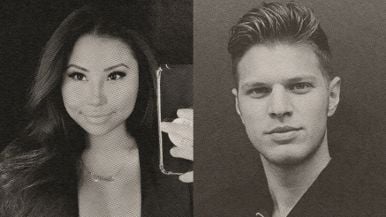
“This was a fictional world, but it still felt healing”: Heated Rivalry star Harrison Browne on blazing a trail for trans athletes
The former pro hockey player talks about the power of visibility, scoring a role on the most popular show on earth and longing for room service

Ten years ago, Harrison Browne made history as the first out trans athlete in American pro sports. Then a star centre forward for the NWHL’s Buffalo Beauts, Browne retired early because the league’s anti-doping requirements stood in the way of his medical transition. He has since become a prominent trans activist: last year he released the book Let Us Play: Winning the Battle for Gender Diverse Athletes; his short film, Pink Light, premiered at TIFF and—the ultimate hat trick—he scored a supporting role on Heated Rivalry. “You never know what’s going to hit in terms of the zeitgeist,” says Browne of the show’s stratospheric success. Here, he tells us about true allyship in professional hockey, the scenes that made him well up and Ilya’s Russian accent.
Did you always plan to follow up your hockey career with one in acting? Not at all. I was definitely not a theatre kid. It was all hockey, hockey, hockey. Then, after I came out as trans, I started getting a lot of media attention. Cameras followed me around for two years, and I started getting asked to speak at different events. I realized there was a lot of power in my visibility, and this was all happening at a time when there was a lot of controversy around straight actors playing trans characters: there was Jared Leto in Dallas Buyers Club, and then Scarlett Johansson was supposed to play a trans role in a project that got quashed. I thought, Maybe this is a space where I could continue to represent the trans community in my post-hockey life. One of the first things I did was an improv class at Second City, and I just loved it.
Related: “We deserve a gay show that is sexy and horny and fun”—Jacob Tierney on his new queer hockey romance, Heated Rivalry
Did your activism help you in terms of booking the Heated Rivalry gig? I’m not sure. I got the audition through my agent. When I saw it was a hockey show, I figured that meant I had a good shot, and then when I saw it was also an LGBTQ script, I was definitely hopeful. It was a self-tape audition, and they asked about any skating experience along with other basics. I was like, “Hi, I’m Harrison Browne, I’m five foot five and I’m pretty good at hockey.”
That seems like a pretty glaring understatement. Well, I said that I had played division one and then pro, so I think they got the idea. Initially, I had auditioned for a different role: Shane’s friend who has all the babies. I didn’t get that one, but then Jacob Tierney reached out to my team to offer me the part of Connors.
How would you describe your character? Connors is one of Ilya’s teammates on the Raiders. There wasn’t much prep to do. I know the hockey world very well, obviously. It was more getting over the imposter syndrome that I was feeling based on my stature. The other hockey player in the scene with me is like six foot five. I walked onto set and there was this very muscular, handsome, large man. I just had to get out of my own way to stand in my power as a former professional hockey player.
Related: How Heated Rivalry’s intimacy coordinator choreographed the show’s steamiest sex scenes
You shot your scenes with Connor Storrie, who plays Ilya. What was he like? Really lovely. Before shooting started, I was looking at the call sheet with my partner, who is also an actor. Turns out she had done an acting class with Connor in the States, so I was able to bring that up. It was a pleasure doing my scenes with him. One funny thing was that he kept his accent for the entire shoot. I didn’t hear his real voice until the wrap party.
Was there a scene you most enjoyed shooting? The club scene was fun. I think it was only the first or second day of shooting, so there was a lot of excited energy on set. And then shooting any club scene is fun. In this one, we got to dance to actual music. Usually you’re silent dancing, so it was nice to actually dance and not awkwardly mime it.
Did you have a sense, back when you were filming, that the show was going to blow up the way it did? You never know when something is going to hit in the zeitgeist, but I do think that, with everything going on in the world, people want some reprieve. With all of the stuff happening in the US and even in Canada, I think there is a desire to see queer joy and queer love stories that are celebratory. A lot of queer entertainment is either entirely focused on the struggle and the difficult history or it’s completely glazing over the hard parts, which doesn’t work either. I think with Heated Rivalry you have nuance—moments when you’re laughing out loud and then moments when you’re crying. I definitely shed some tears watching it.
At which scenes? The kiss between Scott and Kip was really special to watch. If you want to talk about the power of visibility, that scene is just incredible. Also when Shane and his mom have a conversation in the final episode and she tells him that she’s sorry she didn’t create a space or environment where he felt he could be honest about being gay. That is an important shifting of the onus from “Why didn’t you tell me?”
This is a story about two characters who have to hide who they are in order to play the sport that they love. That must be something you can appreciate first-hand. Definitely. My character is a cisgender man, so my experience as a trans man didn’t play into how I approached the role. Some of the cast and crew didn’t know my background, and they thought I was just another cisgender person on set, which was really nice for me after having had the experience where I, as Harrison, didn’t feel like I belonged in the world of men’s hockey. This was a fictional world, but it still felt really healing.
You mean from the time you weren’t out as a trans athlete? Athletes sacrifice a lot for their sport, whether that’s free time or relationships. For me, I knew that I had to put my future on ice. I had to put whatever desires I had aside and just live for hockey. I didn’t think I could mesh my identity as Harrison and playing in a women’s league. It was agonizing, at times, keeping my secret, but there was a lot of joy and celebrating with my team as well. Hockey gave me a lot, but it’s hard to be something you’re not. You have to put on a mask, and any time you put on a mask, it can feel heavy.
You continued to play for a season after you came out but before you started hormone replacement therapy, which would have violated the league’s anti-doping requirements. Was that a relief? In some ways, yes, but there was a different kind of pressure. I really related to Shane’s character, who has the need to be the perfect role model to set an example for other Asian hockey players, to be the beacon of hope for this community. And to Ilya, who felt this responsibility to his family and to Russia. It’s these things sports can hold over you that can make you put yourself second or third or forth. When I came out as trans, I felt a lot of responsibility to show up and be eloquent, to be educated, to be someone people could point to and say, Okay, trans people aren’t bad—look at Harrison.
It can be a lot of pressure to be a role model. But it’s also such a huge opportunity. My follower count has more than doubled since Heated Rivalry came out. I’ve had so many messages from trans fans asking about getting into acting in a way that was similar to when I came out as a hockey player. Or coming to my book through the show, which is awesome.
Heated Rivalry doesn’t address the specific issues that trans athletes face. Is that something we could see in season two? I haven’t heard any specific conversations, and I don’t think it is the obligation of any one show about queer characters to address all queer issues. But there is a character in Rachel Reid’s books, Max, who is a trans man. I’m not playing that character—at least not at this point.
I’d love to see you get some ice time. It seems like a missed opportunity that the only pro hockey player in the cast never got to lace up. Oh, yeah. Any time I see a sheet of ice, I want to get out there and skate around and show off. Particularly since most of the cast didn’t know how to skate or had very little experience—it would have been nice to skate circles around them. Maybe if I’m back next season.
You have to imagine that the success of this show has entertainment executives calling for “the next Heated Rivalry.” What might that look like? I have heard some calls from people online for sapphic versions of the story, which is really cool to see. I’ll add a little plug for myself: I’m also a filmmaker. I know women’s hockey really well, and I’ve been working on a movie set in that world for a couple of years now. The success of Heated Rivalry has opened a lot of doors for that script. But it’s also just human stories, queer stories, stories of triumph over struggle. I think people want to see more humanity and more variety. You see a lot from the Hollywood machine where it’s the same people playing different characters. Seeing what a fresh face or faces can do is really exciting for actors. They’re not just going to keep using the same formula because the formula has been broken.
The show has gotten a lot of attention for its unapologetically explicit sex scenes. I saw an interview where François Arnaud was talking about a US streamer that wanted no sex until episode five so it didn’t scare away viewers, which was obviously not the direction the show took. I think viewers can tell when sex is gratuitous and just a way to get attention, but in this story, sex is the language that these characters talk through. That’s something a lot of gay and queer men can relate to, if you think about Grindr or hookups where you don’t say anything or you don’t know the person’s name—and that’s commonplace within the queer community. I think the sex was done really well. And then you also have episode five, which has no sex at all because Shane and Ilya have found a different way to communicate. The lack of sex really spoke to the emotional depth and was powerful in a different way.
What kinds of reactions have you observed from the hockey community? The NHL has definitely gotten on the bandwagon in terms of supporting the show and wanting to communicate that via their social media accounts. I have seen some fun content from Boston and Montreal, which are the cities that Ilya and Shane play for in the Heated Rivalry universe.
Gary Bettman, the commissioner of the NHL, recently talked about bingeing the show and how much he enjoyed it. Were you surprised? I wouldn’t say I was surprised. It is savvy to keep up with your audience, and the NHL has acknowledged that the show has resulted in a spike in viewership. On the one hand, it’s great. On the other hand, just as all of this was happening, the Florida Panthers were showing up at the White House to celebrate with Trump. I hope watching the show helped Gary Bettman understand an important perspective. How would Shane and Ilya have felt when the league banned Pride tape? Or about the fact that Bettman is a member of Trump’s Council on Sports, Nutrition and Fitness along with Wayne Gretzky and Matthew Tkachuk? The opportunity that sport has to stand with trans athletes is huge. That is the kind of allyship I would love to see, and to be clear, there are some great people in the NHL who are working for progress: Patrick Burke, Nora Cothren. I want to acknowledge the amazing work they are doing.
Brock McGillis, the first openly gay pro hockey player, has said that he doesn’t think the show will move the needle in terms of systemic homophobia in hockey: “I don’t believe that many hockey bros are going to watch it. And I don’t think, if they are watching it, they’re talking about it positively.” Thoughts? I think that it’s presumptuous to make that kind of sweeping statement. You never know what people are watching. A lot of people have guilty pleasures, whether they’re a big macho man or a figure skater. From my own experience, I work out at a CrossFit gym, and a lot of gym bros have come up and told me they’re enjoying the show. It’s nice to see people who are secure enough in themselves to say, “Yeah, I watch the show.” It’s a green flag.
The internet and particularly the meme-osphere has embraced this show rather intensely. Have you seen anything particularly funny? In terms of Connors specifically, one thing that happened after my episode came out was this “Justice for your room service” movement. People on social media were saying they know what it feels like when you just want to stay in and someone forces you to go to the club. It’s not like I had any idea reading the script that this would be a thing, but now it’s a meme.
Well, now I have to know. What were you going to order? There was a steak with a red wine jus. I’m pretty sure it was a fake menu, but it sounded good.
This interview has been edited for length and clarity.

Courtney Shea is a freelance journalist in Toronto. She started her career as an intern at Toronto Life and continues to contribute frequently to the publication, including her 2022 National Magazine Award–winning feature, “The Death Cheaters,” her regular Q&As and her recent investigation into whether Taylor Swift hung out at a Toronto dive bar (she did not). Courtney was a producer and writer on the 2022 documentary The Talented Mr. Rosenberg, based on her 2014 Toronto Life magazine feature “The Yorkville Swindler.”