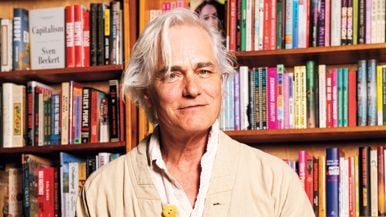
Inside the delightfully absurd puppet studio of Ronnie Burkett
How many puppeteers out there can say they’ve received the Order of Canada?

Unless you’re talking about Jim Henson, famous and puppeteer aren’t two words that tend to appear in the same sentence. But Ronnie Burkett is a rare exception. Since the 1980s, he’s made a name for himself with his original theatrical plays covering dark, intense subject matter and performed by unusual, unsettling marionettes—all of which he painstakingly crafts by hand.
Born in Medicine Hat, Alberta, Burkett won a regional Emmy in 1979 for creating the puppets on the PBS show Cinderrabbit, then went on to earn international acclaim for his plays Tinka’s New Dress, Old Friends and The Daisy Theatre, a solo cabaret show based on underground resistance puppet shows in Nazi-occupied Czechoslovakia, in which Burkett voices more than 40 characters. His awards shelf is heavy: Burkett is an Officer of the Order of Canada and has received a Lieutenant Governor of Alberta Arts Award, two Floyd S. Chalmers Canadian Play Awards, the Siminovitch Prize and several Doras.
On February 27, Little Willy, Burkett’s surreal take on Romeo and Juliet, will open at Canadian Stage. “Little Willy is the stupidest show I’ve ever done,” says Burkett. “It’s absurd that this ragtag little band of misfit puppets are attempting Romeo and Juliet—it’s definitely more vaudeville than Shakespeare. The whole thing is unapologetically stupid, and it’s a total party.”
Related: Fifteen nostalgic artifacts from beloved Canadian children’s shows including Mr. Dressup and Today’s Special
Burkett’s “morgue,” his nickname for his basement studio on Dundas West, is home to around 500 puppets. “A lot of puppeteers use stock patterns, but every one of mine gets designed specifically for the posture,” he says. Below, he takes us on a tour of his studio, sharing the backstories behind some of the freakiest puppets he’s ever made.
Mrs. Edna Rural (early ’90s)

“I was listening to a CBC call-in show back in the ’90s in Calgary. It was the height of the AIDS pandemic, and this woman said: ‘I think they should put all them gays in concentration camps near Red Deer.’ I thought, Someday I’m going to make a puppet of one of those Edna Rurals and have my way with her!
“She wears a classic prairie house dress, and her legs were cannibalized from a pig puppet I had made previously. I’d never rehearsed with her, but when we went onstage, she looked at the audience, and the first thing that came out of her mouth was, ‘Oh lord, love a duck.’ That was my mother’s famous saying! At that moment, I realized I can’t trash this woman—I have to understand her. Edna just became everybody’s mom and everybody’s aunt. She lives in the heart of MAGA land, but she’s not MAGA. She’s full of surprises.”
Schnitzel (1993)

“Schnitzel started out in 1993 as a female fairy named Zelda. At the time, BC’s old-growth forests were being clear-cut, and I wanted to make a fairy who lived in the trees and was losing her home. To me, Schnitzel is a boy, but so many people have called her a ‘she’ that he’s kind of both.
“Schnitzel is the hopeful, innocent part of me. I have a mouth like a trucker and am political, but Schnitzel just wants to fly. That’s his goal. It’s so achingly pure and innocent. I don’t completely understand the audience’s love of Schnitzel, but I know it’s real. I have to stay out of Schnitzel’s way, because if I inject too much of myself into him, it tanks the whole operation. Many years ago, Schnitzel got tangled in something onstage, and I couldn’t get him unstuck, so I just reached down and had Schnitzel say, ‘Ah, fuck it!’ and the place went crazy. A woman came up to me afterward and read me the riot act: ‘I love that little character, and then you had to throw yourself in and say fuck—because he never would!’ She was irate.”
Esme Massengill (1993)

“In the original Daisy shows in the ’90s, Esme was just a bead and feather exercise for me. We wanted to make the design very Gloria Swanson—my drag queen alter ego—and the first entrance she made, she just walked out and fell flat on her face. I was like, Oh, I get it, she’s drunk all the time! She’s the version of me who has been on the road for 50 years and has just had it. She’s very mean, funny and self-centred.”
Tinka (1994)

“I have about 1,600 puppet books, and I was flipping through one called The Art of the Puppet, which I’d had since I was 12. There were a few paragraphs about how Czech puppeteers kept performing illegal daisies during the Nazi occupation, which were called that because apparently daisies grow in the dark. Eventually about 100 Czech puppeteers were sent to the camps, and I thought, I don’t know any puppeteer who is that brave. That was the seed.
“I was living through the AIDS pandemic in Alberta at the exact moment the Reform party was formed. I was hearing the most horrendous hate speech, so I wrote this play about a young puppeteer who goes underground and is put into a camp. After I finished the first draft, I just sobbed for a whole day, because I thought, Well, I just ended my career. Nobody is going to come see a puppet show about this. Instead, Tinka got me into international touring and won me all kinds of accolades, including two Doras, five Sterlings and a special citation at the Obie Awards. Critics didn’t usually review puppet shows, and suddenly I was being recognized alongside serious theatre artists.”
Joe Pickle (2024)

“I noticed a whole block of row houses and commercial buildings that were slated for demolition to build condos when I was on the King streetcar, and that became my inspiration for Joe—so many people are being displaced everywhere.
“Joe is gay, and he’s old, which is the worst thing you can be when you’re gay. It was really important to me to just let him be that. Joe is a great representation of a system of puppet building called counterbalancing, where the puppet’s posture is built into the figure rather than relying on strings to hold it in that stance. That’s why all my marionettes have their own body language. Joe’s neck and humpback were designed like this, so he always has the Joe posture even when he’s at rest. I didn’t want him to be twee. We could have made nice little brogues for him, but I was like, ‘No, he would have a great utilitarian pair of sneakers from Walmart.’”
Little Willy will be at the Berkeley Street Theatre from February 27 to April 5.

Leah Rumack has worked as the deputy editor of Today’s Parent and the features director of Fashion and has contributed as a writer to a long list of Canadian brands including Toronto Life, the Globe and Mail, the Toronto Star, Chatelaine, Elle Canada, Zoomer, the National Post, EnRoute and Re:porter. Her work focuses on travel, food, pop culture, beauty and fashion.