“The moment a writer starts a piece, they already know it’s a failure”: Miriam Toews on her new memoir, A Truce That Is Not Peace
The author of Women Talking talks small-town oppression, the search for reasons to write and what motivated her first foray into the memoir genre

Miriam Toews grew up in a small Mennonite community in Steinbach, Manitoba, a setting that has coloured many of her novels, including A Complicated Kindness, All My Puny Sorrows and Women Talking, which was adapted into an Oscar-winning film by Sarah Polley in 2022. But Toews’s latest book, A Truce That Is Not Peace, out August 26, is her first true memoir. Beginning with a deceptively simple question—Why do I write?—the author casts herself back to her childhood and recalls memories of her father and sister, who both died by suicide. These recollections are interspersed with contemporary scenes from the writer’s family life, which unfolds around the west-end Toronto home she shares with her partner, mother, daughter, son-in-law and grandkids. We spoke to Toews about the futility of writing, the oppressiveness of her hometown and the joys of a matriarchal household.
First things first: what prompted you to write A Truce That Is Not Peace? I started it about a year and a half ago. I was in a period of reflection, wrestling with the question, Why do I write? I was struggling with it. I tend to find out why I wrote something after the fact. Writing itself always seems futile. How could I possibly choose the right words to describe a feeling? But, knowing myself, I had to try. A friend of mine once described this book as building a wall and tearing it down at the same time.
Related: “Toronto is my obsession”—André Alexis on his new short story collection, Other Worlds
That sounds surprisingly pessimistic coming from such a successful writer. From the moment any writer starts working on a new piece, they already know it’s a failure. We try to express our thoughts and emotions, to get them fully outside of ourselves, and of course, we can’t. But the work becomes something in the process. Early on in my so-called career, I would have things so planned out. But, these days, going into a book is like going into a darkness. I’m always a little blind. It’s only afterward that I think, Oh, this was about that. Or I don’t even try. I leave it up to others to figure it out. The parsing of things—I do that less and less.
Does the title of your memoir describe your relationship to writing, then? Yes, exactly. It’s a line from a prose piece by Christian Wiman, an American poet. I thought it was perfect. I’m never going to be calm or at peace or aware or hip to this wisdom that people say they achieve in old age. There are times when writing seems ridiculous and self-indulgent—I should be out there in the world, squirrelling away emotions and experiences, not trying to represent them on the page. But I do. I’m a writer, but I don’t know why.
Many of your books have incorporated events from your life, but this is your first true memoir. What made you want to write more directly about your experiences? I have difficulty with the term memoir. I suppose I’ve been writing about myself forever. But, as I wrote this, and as the structure and tone of the book came together, nonfiction seemed to be the genre that fit it best.
Related: “I knew working in fashion could be unglamorous, but I was surprised by how much”—Vogue writer Christian Allaire on his new memoir
Do you feel any differently about your past after writing about it? I’ve been trying very hard, late in my life, to focus on the present—drink lots of water, live in the moment, be healthy—and also to move forward, look ahead. But I’m obsessive about my past. I keep thinking, wondering and writing about it. My thoughts about it are changing all the time, and sometimes they’re contradictory. I was born and raised—organically, free range!—in a Mennonite community in Manitoba, and so many of my memories of it, its oppressiveness, fill me with rage. Yet I’m also feeling more love for and connection to my past and how it shaped me. I was recently on a road trip through the Prairies, and while I didn’t stop in Steinbach, I thought about it every day. Those big skies brought me back to my life there.
A major figure in the book is your late sister, Marjorie, who died in 2010. I’m in constant dialogue with my sister, whether she’s here or not. She encouraged me to write, all those years ago, and my curiosity and obsession with her is one of the reasons I am a writer. She was my only sibling, six years older, and she had a major impact on me. We grew up together. She introduced me to the world, then she went into it, and then she was gone. She plays a central role in my life to this day. There’s no way I could write a book without her and our conversations being a major part of it.
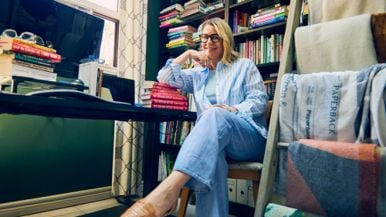
How did it feel to dive into those memories? It was certainly different from writing fiction. I wrote it so quickly. It was like I was being led through it, forced by some outside power. I was just there in my little room in my laneway suite in Queen West, writing and remembering. The difference was the mental work. I’ve used memory to write all of my books, but I didn’t have the freedom of fiction with this one, and I knew I was asking a question that I had no answer to. In the book, I fantasize about making a Wind Museum, which is a metaphor for what writing is for me: a futile attempt at housing wind.
Another motif is the distempered skunk that keeps getting trapped in your window well. Is that a comment on the city’s animal control, or does it have a deeper meaning? That particular skunk has since been taken away by the city. It was sick, and they felt it needed to be euthanized. But now there are other skunks! Its offspring keep coming back. They try to dig into the space under my mother’s bedroom. It must have been their home once. They’re a metaphor for needing to go home but not being able to get there. Part of me thinks we should provide that place for them. But do we really want to say, “Come into our house, skunks, and have your babies”?
This is a home you share not only with your 90-year-old mother but also with your daughter, her husband and their two children. It must be chaotic. Four generations in the same house! I love it. It’s a dream come true. We all have our own space, so we’re not in one another’s laps. I love that my mother is still around and can be with us. And the grandkids too. They’ll come zipping over to my laneway suite for books, taking them from my shelves and pretending to read them. It’s like my own little Mennonite colony—but matriarchal.
You’ve seen your stories appear onscreen, and you’ve even acted in a film. How does the medium differ? Just wait for my contemporary dance. The films were adaptations of my work, but they were their own things. And acting was just a weird one-off. This book feels like a truer fulfillment than the films. I’m protective of it. It’s closer to who I am and what I think. By the same token, I feel uncertain about it. It’s like a conversation—even this conversation. When we’re done, I’ll think, Why did I say what I said? I should have said that differently. I have the same questions you do. Why did I write this? Why did I need to? I’m working through that as a person and as a writer. It’s all just one big why.
After meditating on the question for a whole book, do you have any new insight into why you write? Yes and no. I can say things that sound like answers. Writing makes me feel good. But, really, it’s always been something I just need to do. It’s a necessity for me: water, oxygen, friendship, writing.
This interview has been edited for length and clarity.

Anthony Milton is a freelance journalist based in Toronto specializing in long-form magazine writing. He previously worked as an assistant editor at Toronto Life, where he launched the Front Row newsletter. He regularly contributes all sorts of stories to the magazine, including deep dives on sports, business and housing as well as short-form commentary on our ever-changing city, from its obsession with cherry blossoms to its maddening NIMBYism. His work has also appeared in Maclean’s, Ricochet, TVO, the Trillium and more.