“I didn’t want my mother as my literary critic”: Margaret Atwood’s daughter, Jess Gibson, on her debut story collection
The fiction writer and art historian talks late-in-life confidence, sparse prose and being a Taurus

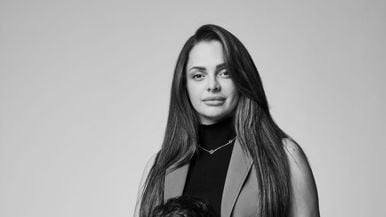
Jess Gibson grew up in a family of writers: her mother is literary giant Margaret Atwood, and her father is the late novelist and environmental activist Graeme Gibson. The younger Gibson, however, took a different path, moving to the US in 2000 to get her PhD in art history at Yale. She eventually settled in Brooklyn and is only now, in the month of her 50th birthday, making her literary debut. Her first book, The Good Eye, is a collection of sharp, punchy short stories about power imbalances, the limits of perception and, occasionally, ghosts. We caught up with Gibson to talk about what art history—and being a Taurus—taught her about writing, why she waited to enter the world of fiction, and what she learned about literature from the authors in her life.
You’ve spent most of your career as an academic. When did you start writing fiction? When I was seven! I learned what work looked like by watching my parents write. Writing and telling stories was just part of what we did. I was quite old before I realized that not everybody told the same story over and over simply because it was a good one. It was also play: I liked to draw a lot as a child, and I’d write stories to go along with the drawings.
How did you go from there to writing a book? I wrote the title story, The Good Eye, just before my son was born in 2016. It was important to me that I was a bit older—I turn 50 in two weeks. Before that, I hadn’t finished any writing projects since my 20s, and I’m not a natural extrovert. That changed after my father died, in 2019. When someone you love dies, you bring a part of them into yourself and carry it with you. My father was no wallflower—he would not have sat on a box of unfinished short stories. He had read some earlier versions and had been excited by them. When Covid came, I moved up to Toronto for a year and a half and put my son into a magical child care pod, where his caretaker would take him and other kids into the ravines to go birdwatching. Suddenly I had all this time, and at a certain point one just has to do the thing.
Related: Toronto is in the midst of an indie magazine renaissance
Where do you find inspiration for your stories? Often there’s an incident or a moment that becomes the germ of story. I’m a Taurus, and we tend to be interested in creature comforts, like soft sheets and dinner, so objects are often a starting point for me. It helps that I’m an art historian too: it’s made me quite visual. Or situations: I was once cooking at a dinner party with a friend, and our risotto just was not getting done. The rice must have been stale, and the other guests were just standing around, waiting. That became part of one of the stories. When I sent my friend the book, I asked, “Did you see our risotto?”
What’s your writing process? I write longhand, in notebooks. I find that, in longhand, I don’t critique myself in the same way as I do when I’m typing, where I can go back and correct something mid-sentence. I find that ruins the idea, even if it’s coming out messily. Then I edit when I transfer it to the computer, and even more so after that. I do a lot of rewrites: most of my stories are unrecognizable from their first drafts.
Your stories are very short, almost like vignettes. What drew you to that kind of brevity? All my stories got shorter after I edited them. I don’t like a lot of extra stuff in my prose. I like it in others’, but not in my own. There should be no filler; every word should be doing something. I also don’t want to put everything in. I’m a very happy reader of murder mysteries, with their delicious clues, red herrings and puzzles that need to be solved. Uncertainty is interesting. It’s like a Rorschach test watching people read these, since there are various interpretations. The brevity supports that: if I give the reader too much, they lose the puzzle element.
Is there a unifying theme across the collection? I had to think about this when I was arranging them. Being a novice, I didn’t know how. I made categories for each story’s topic—the supernatural, fraud, food, art, death and jerks—colour-coded them and arranged them like a puzzle. I wanted to start with a story about rats and psychics, because the reader needs to be able to handle that—if they can’t, they’ve picked up the wrong book. I wanted to end with one about paintings, since the last lines are a quote from Josef Albers about whether we’re perceiving things correctly. In each story, someone is completely misperceiving something but not realizing it.
What made that question of perception interesting to you? As an art historian, I’m always trying to figure out if I am seeing things correctly. I’ve always had to question whether the story I’m telling about a work of art is the proper one, or if there’s another story that can be told. That becomes a real problem when I have to persuasively argue a thesis.
Your parents happen to be two famous writers. Did you find that intimidating as you were writing? No, because they’re just my parents. If I were younger, maybe I would have, since I’d be trying to figure out who I was. But, at this point, their only presence was as a supportive psychic bubble. I grew up around many different types of writers, and their skills weren’t measured by how many books they sold or how famous they were. Success is a matter of timing, luck and zeitgeist. My mother works extremely hard, but she’s also timed things right in a way that’s either lucky or prescient. I understand that some energy will come at me from the world with regard to my parents, but it doesn’t come from the inside.
Did your mom give you any tips? She did exactly what you’d want a mom to do: she said, “I’m so excited! This is so wonderful! Have you told your auntie so-and-so?” I didn’t want my mother as my literary critic, and I think she gets that. One tip she did give me was how to hold a microphone at a reading: close to the chin, not far away.
Related: “Toronto is my obsession”—André Alexis on his new short story collection, Other Worlds
Now that you’ve debuted, what’s next? I have two novels in the works. One isn’t particularly long, but it qualifies as a novel, and the other I’m still finishing. I’ll never write an 800-page book—I don’t have it in me constitutionally. I cut too much. The shorter one is set in Berlin, where I did my dissertation, and takes place both in 2001, when I was there, and in 1984. It also looks at uncertainty and perception, but in a more quest-like way. Memory is tricky: I was writing about places and times I knew of well, and yet I had to order all the Berlin guidebooks I’d used in 2001 from eBay, just to check if the cafés I remembered were still there. It was quite a fun research project, fact-checking my own life.
This interview has been edited for length and clarity.

Anthony Milton is a freelance journalist based in Toronto specializing in long-form magazine writing. He previously worked as an assistant editor at Toronto Life, where he launched the Front Row newsletter. He regularly contributes all sorts of stories to the magazine, including deep dives on sports, business and housing as well as short-form commentary on our ever-changing city, from its obsession with cherry blossoms to its maddening NIMBYism. His work has also appeared in Maclean’s, Ricochet, TVO, the Trillium and more.