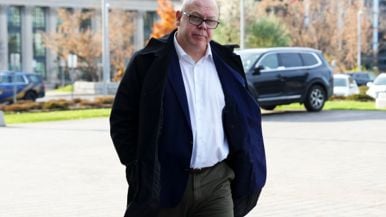
“I was such a nerd. I learned guitar just so I wouldn’t get beat up”: A Q&A with Evan Solomon, Canada’s new minister of AI
The newly minted MP has accepted a precarious portfolio: promoting the power of artificial intelligence without letting it annihilate us all

ChatGPT tells me your new role as the minister of artificial intelligence and digital innovation is focused on government digitization and encouraging the private sector to adopt AI. Can I get a fact check? That’s partly right. Prime Minister Carney decided to create the Ministry of AI based on the idea that this tech is as transformative as the printing press. Having a dedicated ministry means we can support the tech’s growth. My job is to develop a sovereign AI strategy while asking, “How can we make sure it causes more good than harm?”
Has this sovereign policy been in the works for a while? For too long, Canada has been a farm team for the US: our best minds can’t get funding, so they leave. Our new strategy will foster more homegrown research. It will also invest in high-potential companies. Ottawa has invested $2 billion into building domestic data centres, which are essentially digital storage facilities. Today, most centres—and the data they store—are owned by American giants like Meta. We want to ensure that Canadian data benefits Canadians.
Related: A high-tech greenhouse in King City is sticking it to Trump’s tariffs
Prime Minister Carney has said that AI will build the economy of the future. Are we talking science fiction here? The internet brought about the democratization of information. Now AI is democratizing intelligence: making the ability to analyze data, automate tasks and improve decision-making more accessible. It turns all of this information into the predictive models that make inventions like ChatGPT possible. So many things that used to take tons of time now happen in seconds.
Do you consider AI a threat? AI raises important concerns relating to privacy, safety and job loss. But there’s also a huge number of new jobs that have already been born from this revolution—in 2023, the AI workforce grew by 30 per cent, and today roughly 150,000 people across the country work in the field.
Which emerging AI companies are you most jazzed about? The Toronto-based firm Ada provides personable AI customer support agents to slash wait times. There’s also GlüxKind, from Vancouver, which is developing a self-driving baby carriage.
Self-driving baby carriages evoke the kind of dystopian imagery that makes people not like AI. That’s fair. But AI can also invent medicines in months as opposed to years. It can build homes faster and greener. It can track the prevalence of pollution better than any human. Its potential is enormous.
Carney has been the subject of deepfakes. Have you? That’s a personal question.
I wasn’t talking about porn. Neither was I.
But now that we are, how will you protect Canadians from this kind of exploitation? Google just announced a plan to watermark images for authenticity, which seems promising. But you’re always going to have people finding ways around laws. If you live in an apartment building, for instance, and someone gets beat up in a stairwell, do you then close all the stairwells? Hard cases make bad laws.
Meaning you plan to enact looser regulation? Meaning maybe the former government was too focused on drafting the perfect regulatory structure when such a structure doesn’t exist. But we’re still coming up with regulation. There’s just no life jacket yet.
Were you always a techie? Yes. My science teacher at Crescent School, Jim Wright, taught an incredible course called Men, Science and Technology—I realize that title is problematic—and I was obsessed. Then, early in my career, I was a co-founder of Shift magazine, chronicling the rise of the internet.
You’re a rookie MP. Why join politics now? I’ve always loved politics. I actually took a girl on a date to a political convention when I was 15. I was such a nerd. I learned guitar just so I wouldn’t get beat up. As for the new job, I was living and working in New York for GZero, a publication on global affairs, when the prime minister called. Nothing was guaranteed, but being in the US under Trump, watching him bully Canada—that was hard to witness. I remember my wife saying something like, “We are the right people to join this fight.” We just couldn’t stand on the sidelines.
This interview has been edited for length and clarity.

Courtney Shea is a freelance journalist in Toronto. She started her career as an intern at Toronto Life and continues to contribute frequently to the publication, including her 2022 National Magazine Award–winning feature, “The Death Cheaters,” her regular Q&As and her recent investigation into whether Taylor Swift hung out at a Toronto dive bar (she did not). Courtney was a producer and writer on the 2022 documentary The Talented Mr. Rosenberg, based on her 2014 Toronto Life magazine feature “The Yorkville Swindler.”