The DIY Maestro
How to respond to a millionaire who’s willing to pay big money to conduct your orchestra? The TSO said yes. Its musicians said, Seriously? And Mandle Cheung got to raise his baton at Roy Thomson Hall. A story about outsized ambitions, cash-strapped arts organizations and the limits of wish fulfillment
The first time I heard Mandle Cheung’s name was at rehearsal this past May. As I, along with the other 100 members of the Amadeus Choir, pulled out copies of Gustav Mahler’s Symphony No. 2, our conductor, Kathleen Allan, announced that we would be performing the piece the following month with the Toronto Symphony Orchestra—under “Mandle.” A murmur travelled through the rows.
I didn’t know who or what “Mandle” was, but many of my fellow choristers did. The 78-year-old multimillionaire and tech entrepreneur had made small waves in Toronto’s classical music community. Without any formal musical training, Cheung has been paying to conduct the greatest works of the classical canon with the best musicians he can find. Opinions varied wildly. Some said he couldn’t conduct to save his life, others that he was actually quite good. Some called him an egomaniac, others a true patron of the arts. There was consensus on one thing only: Mandle Cheung paid well.
Mahler’s second symphony, also known as the Resurrection Symphony, is the late-Romantic composer’s 90-minute reckoning with death. It’s an incredibly powerful piece, a marvel to perform and almost overwhelming to listen to. It is not for beginners. Over the next couple of weeks, our choir rehearsed with Allan. She turned the piece inside out, as is her way, dissecting its dissonant chords, obsessing over its German diction, pointing out its musical antecedents. Allan holds our choir in the palm of her hand: when she asks us to shimmer, we shimmer. “Swim like a school of fish,” she says, and suddenly all voices are singing as one.
The piece was in good shape when we filed into the choir loft of the George Weston Recital Hall one evening in early June. Standing in the wood-panelled performance space that forms the nucleus of the Meridian Arts Centre in North York, we overlooked the orchestra fanned out on the stage below, its young members filling the hall with the din of tuning instruments. From my vantage point in the front row, I quickly spotted the diminutive man with perfectly coiffed black hair perched on a stool at the conductor’s podium. I watched as Cheung arranged Mahler’s massive score on his music stand and fiddled with his cellphone. Excitement hung in the air, as did the question: Could he actually conduct?
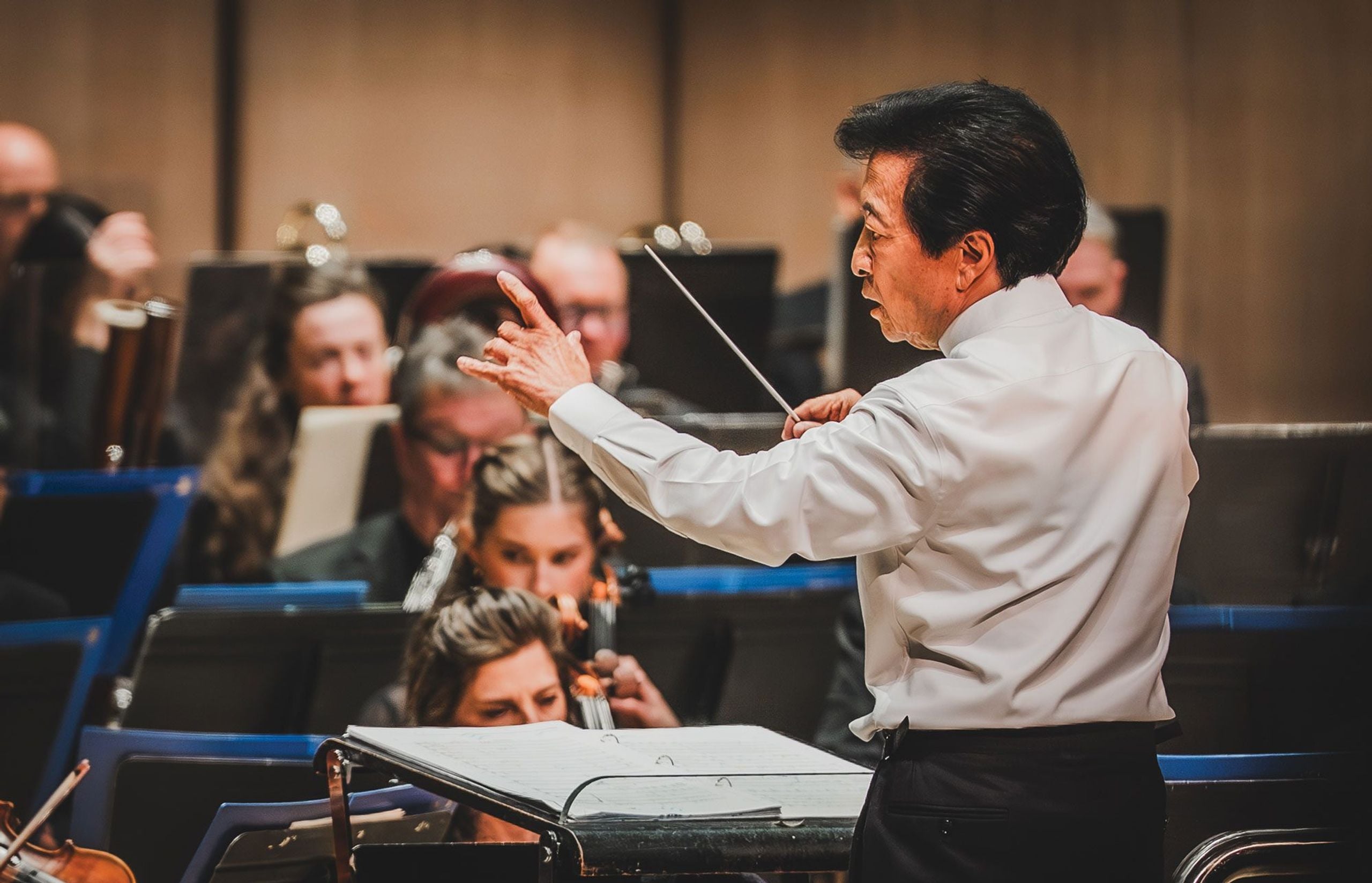
At inaugural rehearsals like this one, conductors usually introduce themselves—to establish a connection and to set the tone for the collaboration ahead. Cheung skipped these formalities. Scanning the more than 200 musicians assembled before him, he simply called out a rehearsal number—one of the boxed numbers on a score that serve as signposts—and raised his baton.
In Mahler’s second symphony, the choir enters in the fifth and final movement for the last 15 minutes. As Cheung brought down the baton, we started to sing a passage so quiet and so plaintive that it almost hurts. The text, written largely by Mahler, suggests that death is not the end but the beginning. When our choir performed the piece in 2019 with the TSO under British conductor Matthew Halls, I made the mistake of thinking about people I’ve loved who have died and found myself fighting back tears.
Cheung betrayed no emotion. With his head bent over the score, we saw only glimpses of his face, and it was fixed in concentration. After a couple of minutes, he lowered his right arm—not the looped gesture conductors use to end a phrase, or the sudden brake for when they want to interject, just an unceremonious halt. The music petered out. Without comment, Cheung flipped around in his score, called out another rehearsal number and raised his baton.
This happened again. And again. And again. I reminded myself that the French word for rehearsal is, after all, répétition—except that rehearsals are usually punctuated with feedback from the conductor in the form of insights, requests, funny little asides. Cheung had little to say, unless he wanted more.
If I had spent my life working to be on that stage, I too might have resented submitting to the baton of someone who had bought his way in
“Really belt it out,” he instructed the choir as we recovered from the marathon of explosive notes that end the piece. “Give it everything!” A few of my fellow sopranos rolled their eyes: there’s only so much belting you can do on a high A. Professional conductors generally have an understanding of the instruments they command—the bowing techniques on the violin, the registers of the clarinet, the limits of the vocal apparatus—and are unlikely to repeatedly ask for full throttle on top notes. I wondered how much Cheung would ask of us, and how much we would be willing to give.
Classical music performance has several layers. There’s the choice of repertoire and the interpretation of the music. There’s the relationship between the ensemble and the conductor, a kind of emotional force field that develops over the rehearsal process. And there’s the question of who is footing the bill. Rarely are all of these the dominion of a single person.
Arts organizations in this country do what they must to stay afloat. For our choir, it’s a relentless succession of raffles, 50/50 draws, fundraisers and ticket sale drives. We’re also available for hire, whether that means singing the score of Titanic or The Lord of the Rings at live screenings or performing Handel’s Messiah on demand at Christmas. But never before had we been handed over to an amateur. The financial rationale for the collaboration was clear, but what would it sound like? And who, really, was the man holding the baton?
Nine years ago, Cheung presented himself in David Kent’s office at Roy Thomson Hall. Kent is something of an institution within the TSO. For the past four decades, he has served as the orchestra’s principal timpanist—the square-shouldered man in the back row surrounded by kettledrums—and as its personnel manager, responsible for hiring extras, administering auditions and, as he puts it, “dealing with human problems.” Cheung had a question for Kent that stopped him short. He wanted to start conducting, having never done it before.
As timpanist, Kent has long stretches of rests: lots of time to observe audiences and consider why, for the most part, they watch the conductor, the one person onstage who is not making any noise. “The conductor is half traffic cop and half magician, the sorcerer with the wand on the podium,” he told me on a call from Florida, where he spends non-orchestral time. “I think people sort of relate to conductors. Don’t we all, in a way, want to be in control of our own destinies?”
Cheung told Kent that his ultimate goal was to conduct Mahler’s second symphony. For conductors, this piece is Everest. Its orchestration is vast—especially in the brass section: nine French horns and eight trumpets—and the volume generated by the ensemble is, at times, terrifying. As the orchestra builds to the fortissimo chords Mahlerites call “the death shrieks,” players often slip in ear protection. Its key signatures and tempos keep shifting, and the score is peppered with the composer’s precise instructions; twice, Mahler calls for an offstage ensemble to play behind the main orchestra—once “a maximum number of horns, blown hard and from a great distance,” and later trumpets, triangles and bass drums “barely audible as though carried by the wind.”
Related: The best stage performances coming this fall
Cheung’s choice of Mahler’s second didn’t surprise Kent. “If you love to drive great cars,” he says, “you’re going to aspire to get behind the wheel of a Maserati.” He was fascinated by Cheung’s ambition and wanted to help. Better positioned than most to make his dreams come true, Cheung had a second grand piano installed in his Richmond Hill home. He hired rehearsal pianists—introduced to him by Kent—to play for him. As they hammered out the piano reductions of various symphonies, Cheung followed along on the score. Kent helped him connect what he heard with what he saw on the page. He calls the task Cheung set himself “gargantuan.”
But Cheung was on a roll. He put out word among his few musical contacts that he was forming an orchestra. News spread quickly. In the spring of 2016, some 25 instrumentalists gathered at the Heliconian Hall, a board-and-batten church in Yorkville that is the neighbourhood’s last remnant of humility. Woosol Cho, a freelance viola player then in her late 20s, was one of them. As she recalls, they rehearsed Mahler’s fourth symphony.
Over time, the rehearsals became regular, and the number of musicians grew. In November of 2018, the Mandle Philharmonic Orchestra mounted its first concert: Mahler’s fourth and Beethoven’s fifth symphony (known for its portentous da-da-da-dum opening) at the Glenn Gould Studio, the 337-seat concert space in the CBC’s headquarters. Tickets were pay-what-you-can. The rows were full. Since then, the Mandle Phil has put on 15 concerts, all classical chestnuts. Cheung offers deep discounts on tickets; he likes his houses to be packed. Cho now serves as the orchestra’s principal violist and contractor, responsible for sourcing musicians as needed. She says it’s not hard to find willing participants.

In the world of freelance musicians, a reliable and well-paying employer is a precious thing. A professional singer in his 30s who was hired to rehearse and perform in Cheung’s 2022 performances of Beethoven’s ninth symphony, the iconic Ode to Joy, was paid $45 an hour—$15 more than he was used to. “Mandle didn’t really know what he was doing,” the singer told me. “At times, he was just waving his arms.” At one point in the concert, Cheung apparently got lost in his score and began conducting the wrong movement. It didn’t matter. “Musicians at this level can play these pieces in their sleep,” the singer said. He is less concerned about the quality of Cheung’s conducting—which, he said, has since improved greatly—than he is appreciative of what Cheung is doing for classical music in Toronto by supporting its players and expanding its audience.
Cheung falls into a long tradition. Classical music has always been beholden to money; were it not for popes, kings and aristocrats, the genre might not exist. And the economics of classical music remain a challenge. With its highly trained musicians, expensive instruments and large venues, there is no cheap way to produce it. But Cheung isn’t your average patron: he’s not underwriting music—he’s paying to be part of it. And he’s not paying to play third oboe. The fact that Cheung wants to be out in front, in charge, raises the question of motivation. Is this about power, ego or something else?
Several musicians I spoke to speculated about that something else. It is public knowledge that, seven months before the Mandle Phil’s first concert, Cheung was charged with manslaughter after driving his Jaguar into a tree in Richmond Hill, killing his son-in-law, Jeff Knights. Some raised the possibility that, through his quest to conduct, Cheung is looking for some kind of redemption.
Twelve days after that first rehearsal in North York, our choir met Cheung again—this time in Roy Thomson Hall. This rehearsal was just for the symphony’s vocal sections. Cheung was again perched on the podium stool, framed by two soloists: mezzo Mireille Lebel, flown in from Berlin and wrapped in a blanket, presumably to ward off the air conditioning, and soprano Kirsten LeBlanc from Montreal, in a sundress.
Cheung ran the fifth movement. He frequently turned to Kathleen Allan, who was sitting alone in the middle of the hall, conducting into her lap, for assistance. Once, while conveying to us what Cheung wanted, Allan referred to him as “the maestro.” “Not maestro,” he interrupted. “Mandle.” I wondered if this was a matter of modesty or branding. As Cheung continued to consult with her, Allan moved up onto the stage—until, at Cheung’s request, she took his place at the podium. After she led us through the haunting opening bars, he acknowledged out loud, “Kathleen is so amazing.”
We rehearsed at Roy Thomson Hall the following night, this time with the TSO and the 45 extras needed to meet Mahler’s instrumental requirements. Members of the orchestra’s management team, its resident conductor and Allan were scattered across the hall’s sea of empty seats. For the most part, Cheung’s conducting was mechanical. But, over the last few pages, as the piece rose to its monumental climax, he cut loose—face uplifted, hands flapping. Even his perfect coiffure was dislodged.
By now, word was out. Posters appeared in the subway, advertising the concert—as well as “exclusive promotions” on tickets—in golden font. Five days before the performance, an article by Globe and Mail arts reporter Josh O’Kane cited “deep concerns” within the orchestra that the amateur conductor “would not be able to tackle the intricacies of the complex symphony, risking the TSO’s reputation.” The players quoted declined to be named for fear of professional repercussions. On the morning of the concert, O’Kane appeared on CBC Radio’s pop culture show Commotion to discuss, like a sports commentator before a big game, what he would be looking for in the concert. “It’s really going to come down to the cohesion of the musicians,” O’Kane told host Elamin Abdelmahmoud, calling it “a massive privilege” to conduct Mahler’s second symphony.
That evening, the choir assembled in a holding space in the bowels of Roy Thomson Hall. Cheung had provided trays stacked high with catered sandwiches—a kind gesture and certainly not standard practice. In the hall above us, the concert had already begun. Squished together in the windowless space, we cycled through the trills, whines, buzzes and yawns of our vocal warm-up.
Following Mahler’s instructions to the letter, Cheung insisted that the choir enter during a long pause after the first movement. We filed into the loft that forms a shelf above the orchestra. The hall was packed. Cheung, wearing a starched white shirt with a Nehru collar, looked very much the conductor, confident and in command, and the TSO, gleaming under the stage lights, looked very much the orchestra. There was nothing to suggest an imminent revolt.

Cheung raised his baton. The choir had three movements to sit, watch and listen. I did my best to gauge the energy between the podium and the players. The orchestra sounded first class: the entries clean, the solos exquisite.
Although Mahler wrote his second symphony in the 1890s, it feels cinematic in scope. The fifth movement begins with a blast of strings and brass, followed by intertwining musical themes. After about 15 minutes, the music winds down to nothing. Then, from somewhere offstage, a horn plays a perfect fifth, and a flurry of trumpets respond from another invisible location. In the orchestra, a flute and a piccolo begin a birdlike conversation of their own, after which there is silence. Then the choir begins to sing, seated, motionless and a cappella.
The audience in Roy Thomson Hall was perfectly still: there was no sneezing or unwrapping of cough drops or shifting in seats. Gradually, the music built from the triple piano to the triple forte that Mahler requested. As we sang the last bars, I had the feeling that everyone—Cheung, the TSO and the choir—was giving everything they had. Our common goal was to honour Mahler’s work. The final tremendous chord was still echoing when the audience leapt to its feet.
Cheung turned to the audience. He did not take the sweeping bow that most conductors do. Instead, he pivoted back to us, the musicians, beaming. He gestured for the orchestra to stand, then the soloists and the choir. He invited Allan onto the stage to take a bow. He left the stage and returned. He wandered through the rows of musicians, inviting them to stand by section. He left the stage and returned again. The standing ovation lasted nearly four minutes.
There were more than 2,000 people in the audience that night, and clearly, from their perspective, the performance was a success. So I was particularly curious, two weeks later, to talk to TSO cellist Lucio Ticho and violinist Bridget Hunt. Most members of the orchestra didn’t want to discuss the concert. But Ticho and Hunt, as respective chairs of the orchestra and artistic advisory committees, which liaise between the musicians and management, felt entitled, if not obligated, to represent the orchestra’s concerns.
“Never in my years have I been in this position where I played a piece of that magnitude with a conductor that inexperienced,” said Hunt, who joined the TSO in 1994. She likened management’s announcement that an amateur would be conducting Mahler’s second symphony to “this little…I won’t say a bomb,” letting the word land between us. Ticho, who has been with the TSO for three years, told me the orchestra was “pretty much unanimous” in its opposition to the concert.
As is routine after performances with non-TSO conductors, Hunt’s artistic advisory committee distributed a conductor evaluation survey. Fifty-two of the 63 members who played the concert submitted responses. “A big majority were concerned about what happened and the level, or the lack of level, of the concert,” Hunt explained. For her part, she’d had one goal during the performance: “getting to the end of the piece without a train wreck.” Kent, the timpanist who stands metres from Hunt onstage, offered up a very different take. During his four decades with the TSO, he had watched the odd professional conductor drive the orchestra, as he put it, “right into the ditch.” He said the Mahler performance wasn’t anywhere near the ditch. He referred to the naysayers in the orchestra as “a disgruntled rump.”
Having participated in the concert, I can’t say that I felt anything approaching a train wreck or a ditch either. I felt the power of Mahler’s music, the excellence of the orchestra and the excitement of the audience. Cheung pulled it off. At the same time, I’m not a music critic or a Mahler aficionado or, like the members of the TSO, someone who makes a living playing music. If I had spent my life studying, practising and auditioning my way onto that stage, earning the right to be there, I too might have resented submitting to the baton of someone who had bought his way in.
Ticho and Hunt are fully aware of the financial challenges orchestras face, but they don’t believe in compromising artistic ideals. They are willing to play the crowd-pleasing fare—tribute concerts to Tina Turner and the Bee Gees, accompanied screenings of Elf and Star Wars—that the TSO puts on in the interest of its bottom line. But Cheung conducting Mahler was, for them, a whole other level of wrong.
When Cheung embarked on his quest, he had no idea that he was following in the footsteps of Gilbert Kaplan, an American businessman who, after selling his roughly $100-million media empire in 1984, devoted the rest of his life to conducting, of all things, Mahler’s second symphony. It’s no coincidence: the piece is both the ultimate conducting challenge and inordinately expensive to produce.
“There’s always a healthy tension between art and commerce,” said the TSO’s CEO, Mark Williams, when we spoke in the summer. A Cincinnati native who grew up in a household thrumming with R&B, gospel and soul, he took up the French horn in school before becoming an artist manager and then chief operations and artistic manager for the Cleveland Orchestra. When he took the helm at the TSO in 2022, part of his mandate was to expand its reach. Williams called the Cheung project a big risk—as far as he knows, the TSO had never before rented itself holus-bolus to an amateur conductor—but he was moved by Cheung’s dream.
It’s fair to say that he would also have been moved by the money. The TSO’s finances are tight—for four of the past five years, its revenue has just met or marginally exceeded expenses. And while the orchestra is doing its best to grow its audience—its motto last year was “Symphony With Us”—ticket sales still cover less than half of the TSO’s total costs. The orchestra relies on government grants, philanthropy and service-for-hire engagements to make up the difference.
“Mahler’s second is the piece that inspired many of us to go into orchestral music—it is our church,” one long-time TSO player told me
As temperatures were rising over the Cheung concert last May, Williams invited the orchestra’s members to a special meeting in the lobby of Roy Thomson Hall. He reminded the players that the Cheung collaboration had not been sprung on them; the artistic advisory committee had been informed of the project more than a year earlier and had an opportunity to discuss it with management. Williams then shared some details of the negotiations with Cheung, including the sum that had changed hands—a figure orchestra members were asked not to share publicly.
Cheung, however, has openly talked numbers. In an interview he gave to the New York Times that was published two days after the June 25 concert, he divulged that he paid roughly half a million dollars for the pleasure of conducting Mahler, the lion’s share of which went to the TSO (the hall rental rang in at $65,000 or so, and the soloists at $20,000). For the TSO, which took in $7.3 million in fundraising revenue in 2023/24, a $500,000 injection would have been hard to turn down.
But, for others, this figure was one zero short. “Mahler’s second is the piece that inspired many of us to go into orchestral music—it is our church,” one long-time TSO player told me. “To give that away to an amateur conductor for anything less than a transformational gift seems like a lost opportunity.” As a conservatory-educated musician, Williams understood the players’ reticence. But he made an executive decision, and as he pointed out, the June concert fell within the TSO’s season, when the players were still under contract and on salary. “Folks have to remember this is a workplace,” he said.
While the TSO’s management was happy to accept Cheung’s cheque, it also tied itself in knots trying to distance itself from his concert. As its communications manager, Patrick Iun, explained to me in an email full of bold emphasis, the TSO did not promote the concert, sell tickets to it or include it in any of its subscriptions. The Globe and Mail headline, “Toronto orchestra taps amateur guest conductor—to musicians’ chagrin,” must have made management bristle. It was desperate for the public to understand that the orchestra was not the one doing the tapping.
When I asked Williams if he thought the June concert was a success, he paused. “I don’t mean to get too philosophical here, but that’s a really loaded question,” he said. But then he did venture an answer. “It was successful financially for the organization. It was successful logistically. There was a healthy sized audience there, and I felt that the audience really, really enjoyed it. I think we both would agree that a piece of such power and magnitude deserves to be heard. So from that standpoint, yeah, I would say it was a big success.”
In putting its players behind the concert but not its name, the TSO walked a thin line. It wanted to divorce the financial from the artistic. That arrangement may have worked contractually, but it left both Cheung and the orchestra feeling a bit bruised.
Cheung’s house in Richmond Hill is not the fortress of fences and security vehicles that I was expecting. When I drove up there, a week after the concert, I arrived at nothing more than a stately suburban pile, much like its neighbours, tucked away on a quiet crescent. I entered through an abnormally tall front door, and a four-legged creature came bounding toward me across an expanse of polished marble. The thing—a configuration of silver plastic and silicone with a discomfiting blue light where its head should have been—came to a screeching halt and assumed the playful crouch I know well from my own canine (which, however, has a heartbeat). “We’re still programming him,” Cheung called from the back of the house. “What’s his name?” I asked, wondering if the question even pertained. “Don Q,” someone answered—there were a surprising number of people milling around. I figured the name must refer to something digital before catching the literary reference.
Donning a pair of spa slippers from a stack next to the front door, I entered what felt like a cross between a kindergarten, a curio shop and a contemporary art space. There were two grand pianos, multiple seating areas, an array of stuffed animals, and Cheung’s small army of assistants working on laptops and phones and preparing food in the open-concept kitchen. Cheung, dressed in leisurewear and a pair of slides, invited me to sit opposite him on one of two white couches. Behind him, picture windows looked out onto a landscaped backyard with multiple pools. At my feet was a checkered leather hippopotamus; at my back, an embroidered octopus.
I congratulated Cheung on the performance—he beamed—and asked where his passion for music came from. “It’s in the genes,” he said, launching into an exposition of what he calls the genetic psyche, a theory he intends to eventually write about that explains, well, humanity. In his understanding, the three billion base pairs that make up his DNA have been waiting his entire life to express themselves through conducting.
They had a long wait. Born in Hong Kong in 1947, Cheung was the 17th of his father’s 17 children. He stated this nonchalantly, explaining that in those days, men of means took many wives, but that his father’s means had been reduced to almost nothing by the time he came around. Still, Cheung’s childhood was idyllic. Music didn’t play much of a role in family life, but Cheung did learn to play the harmonica at school and recalls being transfixed by a piece of music he heard on FM radio at the age of 13: a violin concerto by Camille Saint-Saëns.
He can’t recall why he chose Canada for university, but he does remember borrowing a total of $1,200 from various family members and paying $385 annually to study computer science (and minor in music) at the University of Manitoba—the cheapest tuition he could find. Wayne Selby lived across the hall from Cheung in his first year in residence. “We were both kind of loners,” says Selby, who is well over six feet tall and a product of the hamlet of St. Lazare, Manitoba. The two made an unlikely pair, but they had one thing in common: a love of classical music.

Selby, now a retired teacher living outside Winnipeg, was struck by Cheung’s fearlessness. He listened in awe as Cheung performed something he didn’t even know existed—the Arthur Benjamin harmonica concerto—with the Winnipeg Symphony Orchestra, for broadcast on CBC Radio. When Selby brought his friend home on holidays, the kid from Hong Kong dove into St. Lazare life, riding horses, paddling canoes, sleeping in tents and joining the family for midnight mass. But, beyond Cheung’s vivacity, there was a yearning. “I don’t know how many times he said, ‘I’ve got to make money,’ ” says Selby.
In the fall of 1973, Cheung, Selby and Selby’s older brother, Ken, drove to Mexico City, where the Selbys knew someone in the art reproduction business. Their idea was to market canvas copies of masterpieces from the likes of Bruegel, Rembrandt and Da Vinci to the people of Winnipeg. They came home with a trunk full of cheap art.
NonOriginals, as they’d called their company, received one order—from the Bay—before going under. That’s when Cheung, then 28, decided it was time to get a steady job. He took a train to Toronto, rented an apartment above a butcher shop on Danforth and picked up a copy of the Globe and Mail. After flipping through the classifieds, he applied for the first position that looked doable: computer programmer for TransCanada Pipelines.
Over the next decade, Cheung hopped from job to job, working in programming, networking and telephone services. He kept getting bored—until he saw an opportunity forming at the intersection of mainframe computers, networking and telephone technology. Why not develop an application that would allow customers to call a number, enter a product code, hear a description and place an order? It was basically online shopping before its time. Cheung made his first sale to Consumers Distributing—the catalogue department store that, at its apex, had 243 outlets in Canada—then signed with a household finance company. He rented a basement near what was then known as Ryerson Polytechnical Institute and hired a couple of young programmers. He learned what “RFP” stood for and began chasing them down.
In 1987, Cheung founded Computer Talk, and over the next 30 years, the company grew to occupy a significant niche in the world of interactive voice exchange systems and contact centre software. Used in virtually every sector that has automated interaction with the public, including health care, insurance and banking, these products service a vast market. Today, the company employs 100 people, and Cheung, who remains CEO, still goes in a couple of times a week.
For decades, Cheung did little other than work. He glosses over his short-lived marriage to Adrienne Skrober, a fellow student at the University of Manitoba. Their daughter, Oriana, grew up largely with her mother. Whenever he could, Cheung listened to his carefully curated collection of classical CDs. Blair Ferguson, who joined Computer Talk in 2005 and now serves as Cheung’s chief of staff, said that employees couldn’t help but be aware of their boss’s passion. When he showed up to work in his Jaguar convertible, the parking garage shook with the sound of classical music.
Cheung likes to muse about many things, including mortality. On the one hand, he says that if he reaches 2045, he may hit what futurist Ray Kurzweil calls “singularity,” when humans merge with artificial forms of intelligence and defeat death. He’s also aware that his time may, in fact, be running out. It was this thought that propelled him to make way for his musical aspirations.
Cheung is a type: a vastly successful entrepreneur who, in his twilight years, is able to do and have pretty much whatever he wants. But, rather than colonize space or buy a tropical island or probe the ocean floor in a submersible, he has chosen to immerse himself in classical music. Asked why, he didn’t hesitate. “There is no better feeling,” he said. We were now sitting on his back patio, the July sun searing through the pergola’s lattice roof. “Your brain is disconnected from anything else in the universe. It’s just the music. I want the tempo. I want the energy. It’s quite incredible. You step on the podium and you’re gone. You’re gone.”
He is adamant that his desire to conduct has nothing to do with that tragic Sunday in April of 2018, when he and his family were heading over to his niece’s home for dinner. The place was within walking distance, but he wanted to give his son-in-law a ride. Security camera footage shows the car travelling at the speed limit—40 kilometres an hour—before suddenly accelerating and veering off the road.
Cheung has no memory of what happened next. Five days later, he regained consciousness in the ICU at Sunnybrook Hospital and learned that Jeff Knights had been killed. He calls the accident the biggest trauma of his life. It took Cheung’s lawyer, Howard Rubel, five years to prove that the crash had resulted from a medical episode—possibly a seizure—that Cheung had at the wheel. Rubel and Cheung went through court proceedings in France, where the car’s computer was manufactured, to gain access to its contents. That, combined with medical evidence, earned Cheung an acquittal. In 2023, all charges against him were dropped. Through that dark time, Rubel watched his client channel ever more energy into music. “It gave him an incentive to focus on creating something really good in life,” says Rubel, who was in the audience at the June concert. “It puts a chill up your spine,” he says of Mahler’s second.
Blair Ferguson’s musical taste runs toward Top 40, pop and oldies, but she attends Cheung’s concerts and, like Rubel, was blown away by the Resurrection Symphony. “I don’t believe he does this to see his name in lights,” she told me. “He does it for himself. And if other people can get on board and enjoy it, that’s just the cherry on top. One of the things I admire most about Mandle is that he doesn’t get caught up in what other people think.”
That’s not entirely true. Two months after the concert, Cheung is still mulling over what he calls “the kerfuffle.” He understands why some members of the orchestra were skeptical. At his very first rehearsal with the TSO, he told the players he was going to try hard to earn their confidence. He never failed to acknowledge their talent, their musicianship and the work they had put in to get where they were. The pushback from the musicians—and what he describes as the media free-for-all that followed—came as a shock. “It just hit me right in the face,” he says. “They’re interested in how to be negative about it, not in the story itself.”
Ultimately, Cheung is realizing a personal dream. He isn’t taking opportunities away from others. He isn’t lowering standards or diminishing the form. And he’s not pretending to be something he isn’t. When I asked why he doesn’t like to be referred to as “maestro,” he said, “I don’t feel like one.” Reviewing the archival video that the TSO made of the concert, Cheung says he sees about 10,000 things he could have done better. But he loves to watch the ovation—all three minutes and 55 seconds of it. He believes it says everything that needs to be said. And he wants to use it as a calling card, because he’s not done with Mahler. Next up is the composer’s eighth, also known as the Symphony of a Thousand, in reference to the number of musicians it requires. Cheung has his eye on what he considers the best orchestras in the world: the New York Philharmonic and the Berliner Philharmoniker.
This story appears in the November 2025 issue of Toronto Life magazine. To subscribe, click here. To purchase single issues, click here.